Are Rohingyas Refugees or Illegal Entrants?
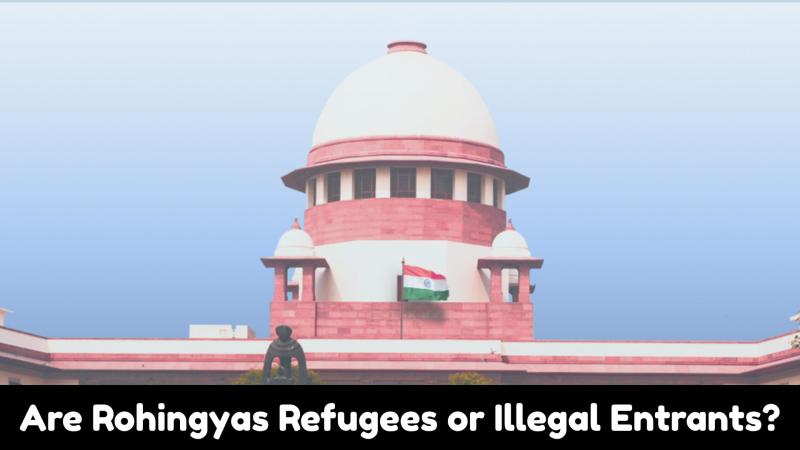
Supreme Court Faces Crucial Test: Are Rohingyas Refugees or Illegal Entrants?
Defining Refugee or Illegal Entrant?
By S Ganapathy
New Delhi: July 31, 2025: The Supreme Court of India on July 31, 2025, took up a litmus-test question: are the Rohingya people living in various parts of India to be recognized as refugees, or should they be classified as illegal entrants under domestic law? A three-judge Bench led by Justice Surya Kant framed the primary question: if they are bona fide refugees, what protections, privileges, or rights do they gain under both Indian statutes and international norms? Conversely, if they are deemed illegal entrants, would that classification justify immediate deportation under the Foreigners Act, and could the government lawfully detain them indefinitely?
The Bench, also comprising Justices Dipankar Datta and N. Kotiswar Singh, emphasized that resolving this threshold issue would render all other connected matters consequential. This approach underscores the Court’s intent to deliver an authoritative ruling that will set legal precedents on how India treats large groups fleeing persecution in neighboring countries. Petitioners and the government alike have been asked to focus arguments squarely on this definitional battle before the Court turns to subsidiary questions of detention, bail, and camp living conditions.
Life, Law, and the Path Ahead
The Court has segregated the pleas into distinct groups: Batch I addresses the refugee vs. illegal entrant status; Batch II examines the living conditions—specifically, whether those residing in designated refugee camps have access to basic amenities like clean drinking water, sanitation, and education; and a third category includes tangential matters, such as indefinite detention of individuals declared as foreigners under prior orders.
Senior advocates Prashant Bhushan and Colin Gonsalves, representing the Rohingya petitioners, stressed that the United Nations High Commissioner for Refugees (UNHCR) has consistently identified this community as in need of international protection, raising claims under the doctrine of non-refoulement—the principle that no refugee should be returned to a country where they face serious threats to life or freedom. On the other side, Solicitor General Tushar Mehta countered that India, not being a signatory to the UN Refugee Convention, retains sovereign discretion under Section 3 of the Foreigners Act to regulate or prohibit entry, especially on national security grounds.
Deportation and Detention
If the Court holds the petitioners to be illegal entrants, it will next confront the legality of their deportation by the Centre and state governments. Petitioners argue that the government’s power under the Foreigners Act is not unlimited and must respect constitutional guarantees, notably Article 21’s promise of the right to life and personal liberty. They contend that indefinite detention without bail is antithetical to fundamental rights and that those not held in custody should enjoy bail under reasonable conditions.
Several lawyers informed the Bench that Rohingyas cannot be kept in detention indefinitely, and that Indian courts have, in the past, quashed similar orders as violative of the principle of habeas corpus. The Supreme Court will need to chart clear legal standards for detention durations and bail eligibility if it upholds the classification of illegal entrants.
Camp Conditions and Article 21
For those Rohingyas living outside detention in makeshift camps across New Delhi, Jammu, Hyderabad, and elsewhere, the pleas allege glaring deficiencies: contaminated water, inadequate sanitation, limited healthcare, and no formal education for children. Petitioners rely on Article 21 interpretations to demand these basic amenities, arguing that every human being within Indian territory is entitled to minimum standards of dignified living, regardless of legal status.
The Centre’s counsel has been asked to provide data on the number of camps, funding allocations, and oversight mechanisms. The Court underscored that any denial of essential services might amount to a breach of the right to life and could influence the broader status determination—potentially creating a humanitarian exception even if refugee status is denied.
Wider Legal and Policy Implications
A ruling favoring refugee status could open doors to formal registration, access to social welfare schemes, and identification documents. It may also compel the government to develop domestic refugee policy, filling India’s long-standing gap of having no dedicated legislation or national framework for asylum seekers. Such an outcome could embolden other groups, including Tibetans, Sri Lankan Tamils, and Afghan nationals, to seek similar recognition.
Conversely, an adverse decision may lead to expedited deportations, stricter enforcement of the Foreigners Act, and increased surveillance along international borders. It could also spur legal challenges under the Constitution’s guarantee of equality before law (Article 14) if only certain groups are targeted for removal, raising questions of arbitrariness and discrimination.
India’s choice will also reverberate internationally. A stance perceived as hostile could strain relations with Myanmar and other ASEAN partners while potentially tarnishing India’s image as a safe haven for persecuted minorities. Neutral observers, including UNHCR, will watch closely for India’s balancing of sovereignty and humanitarian commitments.
Conclusion: A Decision with Consequences
As the Supreme Court embarks on this landmark exercise, lawyers, activists, and governments await guidance on how to harmonize national security with international law and human rights. The Bench has allocated three consecutive Wednesdays to dissect arguments, signaling a comprehensive hearing that could span weeks. Its eventual decision will not only affect tens of thousands of Rohingyas who arrived after fleeing violence in Myanmar but will also chart India’s wider asylum and immigration policy for decades to come.
With such high stakes, the Court must craft a nuanced judgment that respects constitutional guarantees, honors India’s moral obligations, and provides clear legal standards for future cases. Whether the Rohingyas emerge as lawful refugees or forfeited as illegal entrants, the reverberations will shape India’s legal and social landscape in profound ways.
Keywords for Legal Search: Rohingya, refugee, illegal entrant, Supreme Court, Foreigners Act, deportation, detention, UNHCR, non-refoulement, Article 21
For more information visit: https://courtkutchehry.com/
Post Your Ad Here
Comments