Supreme Court Draws Clear Line Between Resignation and Retirement
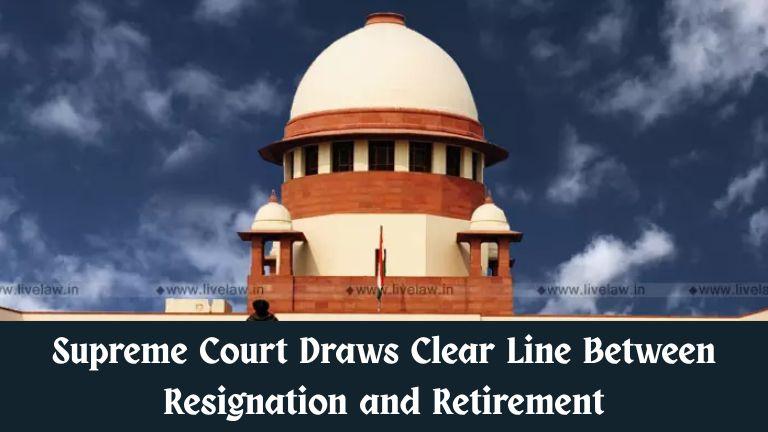
Employees who resign cannot claim pension benefits meant for retirees, says top court
Judgment settles long-standing confusion over employment exit routes and pension eligibility
By Rekha Sharma
New Delhi: July 24, 2025
In a major ruling that will impact thousands of government and bank employees across India, the #SupremeCourt has clarified that #resignation and #voluntaryretirement are two separate legal acts, and employees cannot claim pension benefits meant for retirees if they have resigned from service. This #landmarkverdict ends all confusion and doubt over whether the two most common process through which a government job comes to end mean the same thing, as it involves the same outcome, i.e. end of the government job.
The judgment came in the case of #UnitedBankofIndia (now Punjab National Bank) vs. #SwapanKumarMullick, where the Court ruled that resignation leads to forfeiture of past service, making the employee ineligible for pension benefits. On the other hand, voluntary retirement, which follows specific rules and qualifying service periods, entitles the employee to pension.
This decision has put to rest years of confusion and litigation over whether employees who resign—often due to personal or health reasons—can later claim pension benefits under schemes meant for retirees.
The Case That Sparked the Debate
Swapan Kumar Mullick joined United Bank of India in 1970 and served for over 35 years. In 2006, he submitted his resignation citing mental depression. Four years later, in 2010, the bank issued a circular allowing certain categories of retired employees to opt into a pension scheme. Mullick applied, arguing that his resignation should be treated as voluntary retirement.
The bank rejected his application, citing Regulation 22 of the United Bank of India (Employees') Pension Regulations, 1995, which clearly states that resignation results in forfeiture of past service and disqualifies the employee from pension benefits.
Mullick challenged the decision in the #CalcuttaHighCourt. A #singlebench ruled in his favor, treating his resignation as voluntary retirement. However, a #divisionbench overturned that decision, prompting both parties to appeal to the Supreme Court.
What the Supreme Court Said
The Supreme Court bench, comprising Justices Dipankar Dutta and Ujjal Bhuyan, delivered a clear and decisive verdict. The Court held that:
- Resignation and voluntary retirement are conceptually different.
- Employees who resign cannot later claim pension benefits meant for those who retire.
- Treating resignation as retirement would be unreasonable and contrary to statutory pension rules.
The Court emphasized that resignation is a unilateral act that ends the employer-employee relationship and results in the loss of all accrued service benefits, including pension. Voluntary retirement, however, is a structured exit governed by rules, often requiring a minimum number of years in service and employer approval.
Legal Precedents and Clarifications
The Court referred to several earlier judgments to support its decision:
- In UCO Bank vs. Sanwar Mal (2004), the Supreme Court had already ruled that resignation and retirement carry different meanings, both in common parlance and in service law.
- In LIC vs. Shree Lal Meena (2019), the Court held that resignation cannot be equated with retirement, especially when pension schemes are introduced with retrospective effect.
- In BSES Yamuna Power Ltd. vs. Ghanshyam Chand Sharma (2020), the Court reaffirmed that resignation leads to forfeiture of past service, regardless of the number of years served.
These cases formed the backbone of the current ruling, reinforcing the principle that statutory definitions must be respected, and benefits cannot be claimed retroactively by reinterpreting the nature of employment termination.
Implications for Employees and Employers
This ruling has far-reaching consequences for both public and private sector employees:
- Employees must now be very clear about the nature of their exit—resignation or retirement—and understand the legal consequences.
- Employers are now better protected against claims that attempt to reclassify resignations as retirements to gain pension benefits.
- Pension schemes will now be more consistently applied, reducing ambiguity and litigation.
Legal experts say this decision will help streamline employment law and ensure that benefits are granted only to those who meet the eligibility criteria.
What Employees Should Know
If you're considering leaving your job, here are some key takeaways:
- Resignation is final and leads to loss of pension eligibility.
- Voluntary retirement must follow proper procedures and service requirements.
- You cannot change your exit status retroactively to claim benefits.
- Always consult your HR department or legal advisor before making a decision.
A Step Toward Clarity
The Supreme Court’s ruling is being hailed as a #landmarkclarification in Indian employment law. By drawing a firm line between resignation and retirement, the Court has ensured that pension benefits are granted fairly and legally.
For employees, this is a reminder to read the fine print and understand the long-term impact of their decisions. For employers, it’s a validation of the importance of clear policies and consistent enforcement.
As India’s workforce continues to evolve, such judgments play a crucial role in protecting rights, maintaining fairness, and upholding the rule of law.
For more information, visit- www.courtkutchehry.com
Post Your Ad Here
Comments