How AR Games Use Spatial Mapping for Immersive Experiences?
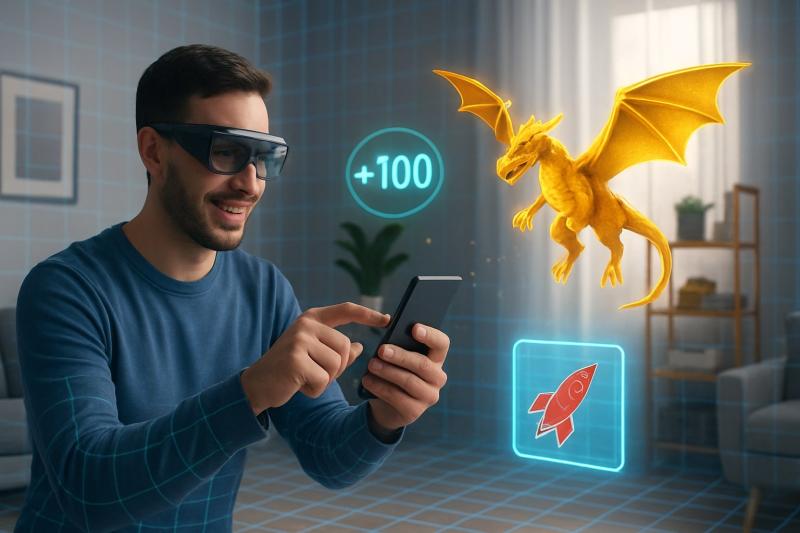
The digital world is not replacing the real one; it is layering over it. That’s the magic of immersive AR tech, and spatial mapping is its backbone.
Whether you are dodging zombies in your backyard or capturing virtual creatures at your neighborhood park, augmented reality games are now defined not just by visuals but by context. The ability to understand, track, and map the environment in real-time transforms AR games from simple overlays to 3D world-integrated adventures.
But how exactly does this work? And what role does ARCore mapping play in creating these deeply engaging, spatial UX games?
Let’s break it down.
What is Spatial Mapping?
At the core of the immersive AR lies spatial mapping. It is the process through which a device scans and understands the physical environment in 3D. It identifies flat surfaces (floors, walls), obstacles, lighting conditions, depth, and even persistent environmental changes. Spatial mapping can turn your room into your battlefield. You can be present in a city park but see a live-action dungeon. This allows:
Anchoring digital assets to real-world locations
Interacting with physical objects dynamically
Enabling multiplayer in shared AR spaces
Building persistent environments that remember previous gameplay
What is ARCore Mapping and How Does it Help Developers?
Developed by Google, ARCore is one of the primary toolkits driving modern AR experiences on Android devices. Its mapping system (Environmental Understanding) detects horizontal and vertical surfaces, tracks camera movement, and constructs a detailed 3D mesh of your surroundings.
But how does it help developers? Let’s explore:
Detects planes for anchoring virtual objects
Offers Cloud Anchors for persistent multiplayer locations
Uses Depth APIs for realistic placement
Provides Scene Semantics to identify elements like sidewalks or trees
This results in a 3D world overlay that’s spatially aware, responsive, and stunningly lifelike.
Why is Spatial UX Important?
AR game development is not just about technology; it is about how players feel when playing. In AR gaming, spatial UX refers to designing interactions that respect the player’s physical space.
It is the difference between ‘clicking on the floating button’ and ‘hiding behind cover (your sofa) to avoid virtual gunfire.’ Spatial UX transforms your real-world location from a status background to an active component of gameplay.
Some of the best spatial UX games have the following features:
Encourage movement through real spaces
Haptics or sound to guide the player’s attention
Adapt to different room sizes and lighting conditions
Context-aware interactions
Examples of Top AR Games
Let’s explore how the top AR games use spatial mapping technology to enhance gameplay:
1. Pokemon GO
Early versions were GPS-based, but new updates use ARCore mapping for better Pokémon placement, occlusion, and even multiplayer raids with shared anchors.
2. The Walking Dead: Our World
Uses geolocation and spatial anchoring to spawn enemies behind trees, next to lamp posts, or on sidewalks.
3. Wizards Unite
Blended real-world locations with magical overlays using persistent mapping, creating personalized AR challenges based on your surroundings.
How Does Spatial Mapping Enhance Immersion?
Spatial mapping does not just render virtual assets; it creates a feedback loop between game logic and the real world. Here is how it works:
- Scan and Detect: ARCore maps the room or street in real time.
- Contextual Placement: The game engine decides where to place objects based on detected surfaces or areas.
- Dynamic Response: Objects interact with the space.
- User Interacts: The player walks, touches, or moves around in 3D.
- Game Recalculates: Scene adapts to new user position or environmental change.
What are the Benefits of Spatial Mapping?
Spatial mapping helps AR games to give a realistic feel, or you can say it plays a vital role in AR game creation. Here are some of its benefits that you should know.
1. Realistic Object Placement
As the name suggests, with spatial mapping, virtual objects perfectly align with real-world surfaces, such as floors, tables, walls, and natural elements, among others. With its natural integration process, the objects appear to sit, stand, or float where they should in real space. The games appear to look so real that you can see them hiding behind your sofa or standing on your desk.
2. Improved Immersion
It allows 3D interaction to respond to the player’s environment, where games and apps can adapt to real spaces, for instance, a horror game using your hallway or a puzzle game using your furniture. With the support of occlusion, meaning AR objects can appear behind real ones, essential for depth realism.
3. Captivating and Natural UX (Spatial UX)
It allows users to interact with digital elements as if they are physically present, creating more realistic gestures, tapping, moving, walking around objects, and more. Using environmental triggers, like entering a room or pointing at a real object, to start interactions.
4. Dynamic, Real-Time Interaction
One more amazing benefit of spatial mapping is that it allows the virtual content to react to real-world changes, and it also helps to recognize moving people or objects. Perfect for adjusting animations when you walk around or block sensors. With real-time spatial occlusion, if something passes in front of the camera, the virtual object hides behind it.
Future of AR Games and Spatial Mapping
We are not far from a reality where entire cities are overlaid with persistent AR worlds. From location-based RPGs and territory control games to real-life dungeons, AR games will evolve significantly in the future.
Imagine defending a digital fortress that actually sits on top of your school building, or meeting your guild at a fixed spot in your city where a virtual portal opens every night at 8.
Here are some emerging technologies that are driving this evolution:
Cloud Anchors for multiplayer sync
Mesh persistence for objects that ‘stay put.’
Occlusion and segmentation for realism
SLAM (Simultaneous Localization and Mapping) for world-scale mapping
Also Read: What UAE Game Studios Need to Know About Developing AR/VR Games in 2025?
How Does This Affect AR Game Developers?
If you are building an AR Game, you are no longer designing just for screens; you are designing for real-world locations. And most importantly, you are designing for movement, exploration, and unpredictability. Here are some things AR developers should prioritize to stay relevant in the evolving landscape:
Device compatibility with ARCore/ARKit
Smart use of depth data and light estimation
Scalable, modular design for indoor/outdoor gameplay
Integration with real-world data (maps, geolocation, object classification)
Final Words
AR games are evolving from screen-tied gimmicks to fully 3D world overlay ecosystems. By harnessing ARCore mapping and building a strong spatial UX, developers can craft environments that feel not just seen but alive. It is not about blurring the lines between real and virtual, but about combining them.
As spatial mapping technology improves, AR will shift from luxury to necessity in interactive game design, like:
- ARCore mapping
- Spatial UX games
- immersive AR tech
- 3D world overlay
Post Your Ad Here
Comments