Copyright Registration for Music and Songs in India: Complete Guide for Creators
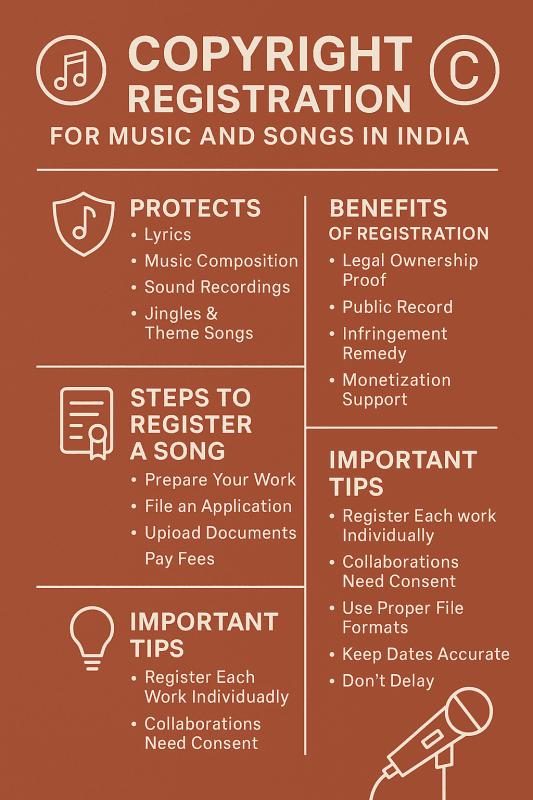
In today’s digital world, where audio content spreads rapidly across platforms, protecting your musical creations is essential. Copyright registration offers a legal shield that ensures your intellectual property rights over music and songs are recognized and protected. Whether you're an independent musician, music producer, composer, or lyricist, understanding the process and benefits of copyright registration in India is crucial for safeguarding your creative assets.
What is Copyright in Music?
Copyright is a form of intellectual property protection granted under the Copyright Act, 1957 in India. It gives the creator of original work the exclusive right to use, reproduce, distribute, or monetize the work.
When it comes to music, copyright can protect:
-
Lyrics (written content)
-
Musical composition (melody, score, arrangements)
-
Sound recordings (produced tracks, MP3s, master recordings)
-
Performance rights (live or recorded performances)
-
Jingles, background scores, and theme songs
You can register each of these elements separately based on the nature of your musical work.
Why Copyright Registration is Important for Music and Songs
Even though copyright exists the moment a work is created and fixed in a tangible form, registering it offers stronger legal protection. Here's why:
1. Legal Ownership Proof
It acts as prima facie evidence in the court that you are the rightful owner of the music.
2. Public Record of Ownership
A registered copyright appears in the public register, making it easier to enforce and license the work.
3. Monetization Opportunities
Registration enables licensing and royalty collection. It simplifies agreements with music labels, streaming platforms, and advertisers.
4. Infringement Protection
If someone copies or uses your music without permission, you can easily take legal action with solid proof of ownership.
5. Helps with Global Protection
A registered copyright in India can assist in securing rights under the Berne Convention, which applies in more than 180 countries.
Types of Music Works You Can Register
You can register multiple types of content as part of a musical project. Here are the main categories:
| Type of Work | Description |
|---|---|
| Literary Work | Lyrics, poetry, written scores |
| Musical Work | Melodies, tunes, musical notations |
| Sound Recording | The actual recorded file (MP3, WAV, etc.) |
| Artistic Work | Album covers, music video graphics |
| Cinematograph Film | Music videos or short films featuring the song |
Who Owns the Copyright in Music?
Ownership of music can be complex, especially in collaborations. Generally:
-
Lyricist owns the rights to lyrics.
-
Composer owns the melody/music.
-
Producer or label may own the sound recording if created under a contract.
-
In collaborative projects, rights are shared unless there's a written agreement stating otherwise.
Important Tip: Always define ownership terms in writing, especially when collaborating with other musicians, vocalists, or producers.
Steps to Register Copyright for a Song in India
Here is a breakdown of how to file for copyright registration for your music in India:
1. Prepare the Work
Make sure your work is complete and fixed in a tangible form, such as a written composition, lyric sheet, or audio file.
2. Visit the Official Portal
Go to the Copyright Office of India and register as a new user.
3. Choose the Appropriate Work Category
You must select whether your work is a:
-
Literary work (lyrics)
-
Musical composition
-
Sound recording
For multiple components (lyrics + music + audio), you’ll need to file separate applications.
4. Fill the Application (Form XIV)
Provide details of the work, the author, and the applicant. If someone else is applying on your behalf, a Power of Attorney is needed.
5. Upload Documents
You need:
-
A copy of the work (lyrics, composition sheet, audio file, etc.)
-
NOC from the composer, lyricist, or label (if applicable)
-
Identity proof
-
Signed declaration
6. Pay the Fees
Fees vary based on the type of work:
-
Literary Work (lyrics) – ₹500
-
Musical Work – ₹500
-
Sound Recording – ₹2,000
(Note: Fees may change; refer to the latest official notification)
7. Wait for Objection Period
The application is published and kept open for objections for 30 days. If no objections arise, the registration is processed.
8. Certificate Issuance
If approved, the Registrar of Copyright issues a certificate and registration number.
Common Mistakes to Avoid
Many artists unknowingly compromise their rights. Here’s what you should watch out for:
-
Failing to Register Different Components: Register lyrics, composition, and recording separately.
-
Incorrect Metadata: File names, author names, or details must match across forms and uploads.
-
No NOC in Joint Works: Collaborative works require NOC (No Objection Certificates) from all contributors.
-
Using Public Domain Beats or Loops: If your track contains unoriginal samples, your registration may be challenged.
-
Delaying Registration: File early to avoid infringement issues down the line.
How Long Does Copyright Last?
In India, copyright typically lasts for:
-
Lifetime of the author + 60 years after their death (for literary and musical works)
-
60 years from publication (for sound recordings and cinematograph films)
This long protection allows multiple revenue opportunities over decades — from licensing, streaming, covers, to sync deals in films and commercials.
Frequently Asked Questions (FAQs)
Q1. Can I register a song even if it's unpublished?
Yes. Unpublished work can be registered, and it’s recommended to do so before public release.
Q2. What if I only have a tune but no lyrics yet?
You can register the musical composition first and later register lyrics as a separate literary work.
Q3. Is copyright valid worldwide?
Not exactly. Indian copyright is valid in Berne Convention countries, but you may need to register in specific foreign jurisdictions for enforcement.
Q4. Can I register a remix or cover version?
Only if you have permission from the original copyright owner. Otherwise, it's a derivative work and cannot be registered without consent.
Conclusion
Registering your music and songs under copyright law in India is an essential step for any serious creator or music entrepreneur. It not only secures your ownership but also opens doors to legal remedies, licensing, and global recognition. Whether you're releasing an original song, producing background music, or composing scores, taking time to officially protect your work gives you peace of mind and control over your art.


Post Your Ad Here
Comments