Rising Demand in Transplant Medicine Fuels Growth in HLA Typing Market
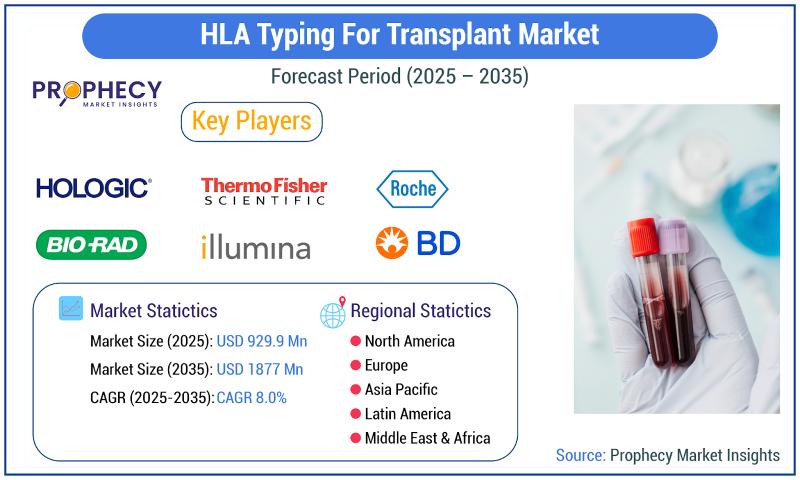
The HLA Typing for Transplant Market is on an impressive growth trajectory as global demand for successful organ and stem cell transplantation continues to rise. According to Prophecy Market Insights, the market, which stood at USD 887 million in 2024, is projected to reach USD 1,877 million by 2035, expanding at a CAGR of 8.0% during the forecast period.
Human Leukocyte Antigen (HLA) typing plays a critical role in determining compatibility between donors and recipients, directly influencing transplant outcomes. The growing incidence of chronic diseases, cancer, and organ failure, combined with advancements in molecular diagnostics, is driving market momentum.
Read the Full Report ? https://www.prophecymarketinsights.com/market_insight/Global-HLA-Typing-for-Transplant-Market-4248
Decoding the Market Segments
The report categorizes the market into several key segments based on product & services, technology, transplant type, application, and end-user profiles.
By Product and Services
The segment includes:
Reagents and Consumables: Test kits, probes, and solutions form a critical supply chain, witnessing consistent demand in laboratories.
Instruments: Molecular-based and sequence-based instruments support high-throughput analysis and precision typing.
Software and Services: Offering data interpretation, analysis tools, and cloud-based support systems that streamline transplant workflows.
By Technology
Molecular Assay Technologies dominate the market, leveraging next-generation sequencing (NGS), PCR, and SSO techniques.
Non-Molecular Technologies are gradually being replaced but remain relevant in certain settings due to affordability.
By Application
Diagnostic Applications lead the space, enabling accurate donor-recipient matching.
Research Applications are expanding due to ongoing studies in immunogenetics and transplant immunology.
By End-User
Independent Reference Laboratories are the largest market contributors, performing large-scale, outsourced HLA typing.
Hospitals and Transplant Centers also show strong demand for integrated solutions.
Academic Institutes and Research Labs foster innovation in testing protocols and compatibility models.
Transplant Type Trends
The market sees higher volumes in solid organ transplants, particularly for kidneys, livers, and hearts. Meanwhile, hematopoietic stem cell transplants are gaining momentum due to their role in treating blood cancers and genetic disorders.
The rising prevalence of leukemia, lymphoma, and other hematologic conditions is directly increasing the demand for stem cell transplants, which rely heavily on precise HLA matching.
Innovation Spotlight
Recent innovations have redefined the speed and accuracy of HLA typing. Technologies like Next-Generation Sequencing (NGS) and real-time PCR enable same-day matching, which is vital for time-sensitive procedures. Moreover, cloud-based analytics platforms are transforming how transplant centers store and interpret complex HLA datasets.
As AI and machine learning integrate with laboratory workflows, predictive compatibility tools are emerging to reduce rejection rates and improve transplant success globally.
Market Leaders Driving Progress
Several global companies dominate the HLA typing space, continuously investing in R&D and product expansion. Key players include:
Thermo Fisher Scientific
Illumina, Inc.
CareDx, Inc.
Bio-Rad Laboratories
GenDx
QIAGEN
F. Hoffmann-La Roche Ltd
Hologic, Inc.
Immucor
These companies are strengthening their portfolios through acquisitions, strategic partnerships, and development of end-to-end transplant diagnostics platforms.
Regional Outlook
North America holds the lion’s share of the market, supported by advanced healthcare infrastructure and a strong donor registry network.
Europe shows sustained investment in transplant research and reimbursement support.
Asia Pacific is emerging as a high-growth region due to increasing chronic illness burden and growing access to transplantation services.
Future Forecast: From Precision to Prediction
The future of the HLA typing for transplant market lies in predictive immunology. As personalized medicine gains traction, matching goes beyond compatibility—it involves long-term immune response prediction, pre-transplant analytics, and post-transplant monitoring.
With the intersection of molecular biology, AI, and cloud-based computing, the market is poised to redefine transplant care delivery over the next decade.
Prepared by Prophecy Market Insights – Your trusted source for data-driven foresight.
Post Your Ad Here
Comments