BPaaS Market to Reach USD 227.6 Billion by 2035: Digital Operations Redefined
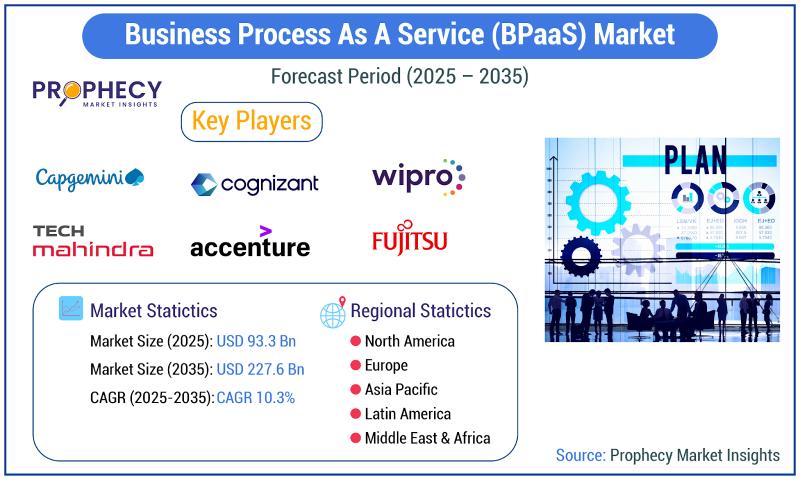
The digital transformation of global enterprises is no longer optional—it’s an operational imperative. Reflecting this shift, the Business Process as a Service (BPaaS) Market was valued at USD 86 billion in 2024, and it's now projected to soar to USD 227.6 billion by 2035, expanding at a CAGR of 10.3%.
BPaaS—a cloud-enabled solution that delivers business process outsourcing (BPO) via web platforms—has emerged as a powerful enabler of efficiency, scalability, and agility across banking, healthcare, insurance, and retail industries.
Learn More:- https://www.prophecymarketinsights.com/market_insight/Global-Business-Process-as-a-516
What’s Powering the Surge?
Prophecy Market Insights analysts point to the convergence of cloud technologies, AI automation, and cost-optimization initiatives as primary market drivers.
“Businesses today seek more than just outsourcing—they seek intelligence and integration. BPaaS is no longer about delegating back-end work; it’s about driving business value with smart, scalable services,” said the lead research analyst.
Key growth contributors include:
Cloud-first strategies across Fortune 500 enterprises
AI-enabled process automation in areas like finance and HR
Demand for agile service models, including pay-per-use and outcome-based pricing
Digital supply chain and omnichannel support in retail and healthcare
Segment Deep Dive: From Intelligence to Integration
BPaaS encompasses a wide array of outsourced business operations hosted in the cloud. The market is segmented by business process, deployment model, and end-use industry.
By Business Process:
Business Intelligence (BI): Empowering data-driven decision-making.
Finance & Accounting: Streamlining invoicing, payroll, and compliance.
Supply Chain Management: Enabling end-to-end visibility and resilience.
IT Service Outsourcing: Reducing infrastructure costs and improving uptime.
Others: Including HR services, customer service, and marketing automation.
By Deployment Model:
Pay-per-use: Offering cost flexibility and reducing CAPEX.
Risk Mitigation Models: Tailored to address security, compliance, and continuity.
Cloud-based Delivery: Dominating due to ease of integration and scalability.
Others: Hybrid and on-prem options for niche requirements.
By End Use:
Banking & Financial Services: Using BPaaS to streamline compliance and customer onboarding.
Healthcare: Adopting digital claims processing and telehealth support services.
Retail & E-Commerce: Enhancing CX and automating fulfillment.
Insurance: Integrating fraud detection and underwriting via digital platforms.
Managerial and Other Sectors: Leveraging BPaaS for internal reporting and resource planning
Tech Titans Driving Transformation
Industry competition is fierce, with top-tier players investing in innovation, cloud-native platforms, and strategic acquisitions. Leading companies include:
Accenture, Capgemini, and Cognizant – known for intelligent process automation.
Infosys, TCS, Tech Mahindra, and Wipro – leveraging AI and machine learning in digital transformation offerings.
IBM and HCL Technologies – integrating hybrid cloud and blockchain-based workflows.
Fujitsu, Genpact, and Sutherland – offering industry-specific BPaaS models globally.
This ecosystem reflects a race to deliver not just services, but measurable business outcomes.
Challenges in the Cloud
Despite the promising outlook, the BPaaS market faces some hurdles:
Data privacy and sovereignty regulations in sectors like healthcare and banking.
Vendor lock-in concerns due to proprietary platforms.
Integration challenges with legacy systems, particularly in emerging markets.
Still, the long-term gains—agility, scale, and cost reduction—are proving too valuable to ignore.
Future Outlook: Beyond Outsourcing
What sets BPaaS apart in 2025 is its transformation from a BPO extension to a strategic digital backbone. With AI, IoT, and blockchain integrations on the horizon, the next decade is expected to see BPaaS platforms moving toward predictive insights, autonomous workflows, and hyper-personalized business services.
“The future of BPaaS is smart, secure, and service-oriented. Enterprises are investing in platforms that evolve with them—not just serve them,” concludes the report.

Post Your Ad Here
Comments