The Future of Learning: How AI Tools Are Reshaping Education Forever
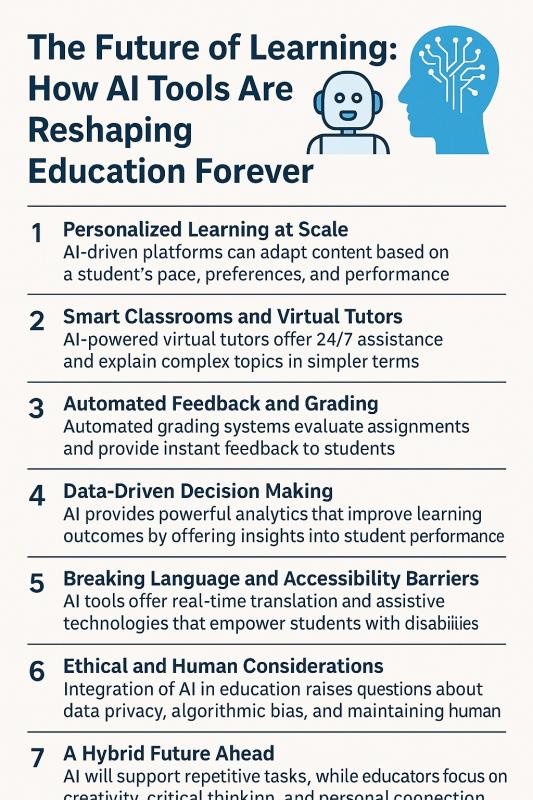
The landscape of education is undergoing a revolutionary transformation, fuelled by the rapid rise of Artificial Intelligence (AI). From personalised tutoring to automated grading systems, AI tools are not just supporting the traditional classroom, they are redefining it.
1. Personalised Learning at Scale
One of the most significant contributions of AI in education is its ability to personalise the learning experience. Traditional teaching methods often struggle to cater to individual learning styles, but AI-driven platforms can adapt content based on a student’s pace, preferences, and performance. Whether it's a struggling student needing extra help or a high achiever seeking advanced material, AI ensures everyone progresses at their own optimal level.
2. Smart Classrooms and Virtual Tutors
The future classroom is not bound by walls. AI-powered virtual tutors are becoming a common part of digital education platforms, offering 24/7 assistance to students around the world. These intelligent systems answer questions, suggest resources, and even explain complex topics in simpler terms, making learning more accessible and engaging.
3. Automated Feedback and Grading
AI tools are streamlining administrative tasks that once consumed hours of a teacher’s time. Automated grading systems can evaluate multiple-choice questions, short answers, assignments and even some essays with remarkable accuracy. More importantly, these tools provide instant feedback to students, allowing them to learn from their mistakes in real time.
4. Data-Driven Decision Making
With the help of AI, educators can access powerful analytics that provide deep insights into student behaviour and academic performance. These insights help institutions identify at-risk students early, adjust teaching strategies, and improve overall learning outcomes. Education is no longer a one-size-fits-all system, t’s becoming a dynamic, data-driven experience.
5. Breaking Language and Accessibility Barriers
AI tools are helping bridge global gaps by offering real-time translation and voice recognition features. Students from different linguistic and cultural backgrounds can now access the same educational material with ease. Similarly, AI-driven assistive technologies are empowering students with disabilities by providing customised learning environments that suit their needs.
6. Ethical and Human Considerations
Despite its many benefits, the integration of AI in education also raises important ethical questions. Issues such as data privacy, algorithmic bias, and over-reliance on technology need to be addressed thoughtfully. It's crucial to maintain the human element in education, empathy, mentorship, and emotional intelligence remain irreplaceable. Moreover, excessive use of Ai tools in the name of assignment help should also be considered an ethical responsibility and hence teachers and professors should ensure that their students are well informed.
7. A Hybrid Future Ahead
Rather than replacing teachers, AI is set to become a powerful ally. The future of education lies in a hybrid model where AI handles repetitive tasks and provides intelligent support, while educators focus on creativity, critical thinking, and personal connection.
Conclusion
The rise of AI tools is ushering in a new era for education, one that is more inclusive, efficient, and personalised. As we move forward, the challenge will be to strike the right balance between technology and humanity. If done thoughtfully, the future of learning could be brighter, smarter, and more empowering than ever before.
Post Your Ad Here
Comments