Hybrid Power System Industry to Surge Past USD 50.1 Billion by 2035 Amid Shift to Sustainable Energy Solutions
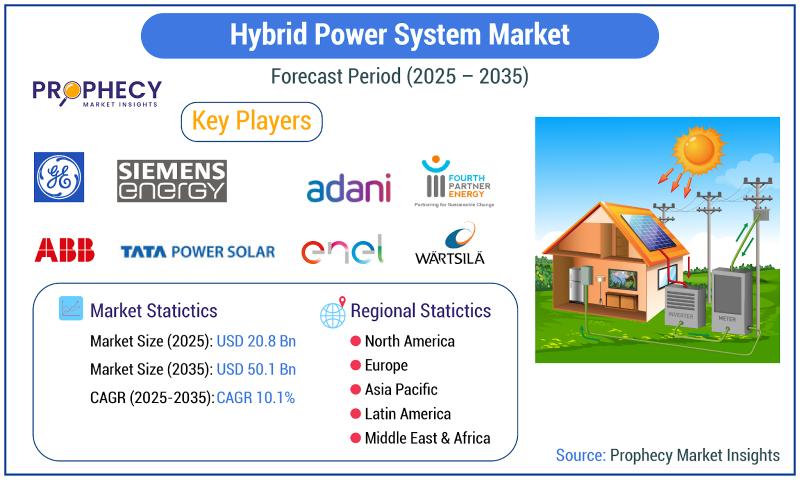
The global energy sector is undergoing a seismic shift, and hybrid power systems are rapidly becoming a cornerstone of the transition. As the demand for reliable, decentralized, and low-emission energy sources grows, hybrid energy solutions—combining traditional and renewable sources—are gaining momentum.
According to industry projections, the hybrid power system industry, valued at USD 19.7 Billion in 2024, is set to reach USD 50.1 Billion by 2035, expanding at a CAGR of 10.1%. This significant growth is attributed to the increasing need for energy access in off-grid regions, supportive government policies, and the global push toward net-zero emissions.
Rising Demand for Energy Resilience and Green Transition
Hybrid power systems integrate renewable energy sources like solar, wind, and hydro with traditional diesel generators. This synergy enables consistent power supply with reduced dependency on fossil fuels, especially in remote or energy-insecure areas.
Industries and governments are now prioritizing:
Lower operational costs
Reduced fuel dependency
Grid independence
Carbon footprint reduction
Such systems are particularly useful in areas where grid reliability is poor or nonexistent, and where renewables alone cannot consistently meet energy demands due to weather variability.
Diverse Configurations for Varied Applications
Hybrid power systems are available in multiple configurations to meet location-specific needs:
? By Type:
Solar-Diesel Hybrid: Most popular, especially in sunny regions with limited grid access.
Wind-Diesel Hybrid: Common in coastal or high-altitude areas.
Hydro-Diesel Hybrid: Used near flowing water sources to enhance reliability.
Others: Including battery-supported and multi-renewable configurations.
These systems balance renewable generation with the backup assurance of diesel, enabling continuous operations with optimized fuel use.
On-Grid vs. Off-Grid Solutions
As energy needs evolve, hybrid systems are deployed across both grid-connected and standalone applications:
On-Grid Systems: Help stabilize power supply, reduce grid load, and lower electricity costs in industrial and commercial zones.
Off-Grid Systems: Widely used in rural electrification projects, mining operations, island nations, and military bases.
Off-grid hybrid installations are expected to witness faster growth, driven by government subsidies and international funding for clean energy access in underserved regions.
Wide Range of End-Use Applications
The adaptability of hybrid systems is attracting stakeholders from various sectors:
Commercial: Office buildings, educational campuses, telecom towers.
Industrial: Manufacturing, mining, oil & gas fields.
Residential: High-end homes, gated communities, rural housing clusters.
With the rising cost of conventional electricity and unreliable grid infrastructure in several emerging economies, residential adoption is also set to rise steadily.
Leading Industry Players and Technological Advancements
Key players are investing in advanced controls, energy storage integration, AI-driven optimization, and scalable modular systems. Some of the top contributors to industry growth include:
ADANI GROUP
Siemens Energy
General Electric Company
ABB
Fourth Partner Energy
Tata Power Solar Systems Ltd.
Wärtsilä
Enel Spa
Huawei Digital Power Technologies Co., Ltd.
Contemporary Amperex Technology Co., Limited.
TotalEnergies
Zenith Energy Pty Ltd
These organizations are expanding their global footprint through joint ventures, government partnerships, and turnkey project deployments.
? Explore Further
To gain deeper insight into the dynamics, players, and projections shaping the hybrid power system industry:
The Road Ahead
With energy security becoming a global priority and the environmental impact of diesel-only systems under scrutiny, hybrid power systems are set to become a mainstream solution. The future of the hybrid power system industry lies in smart integrations, battery storage expansion, microgrid technology, and AI-powered management tools—bridging sustainability with energy reliability.
Post Your Ad Here
Comments