How UAV Skills Are Becoming a Must-Have in Telecom Maintenance?
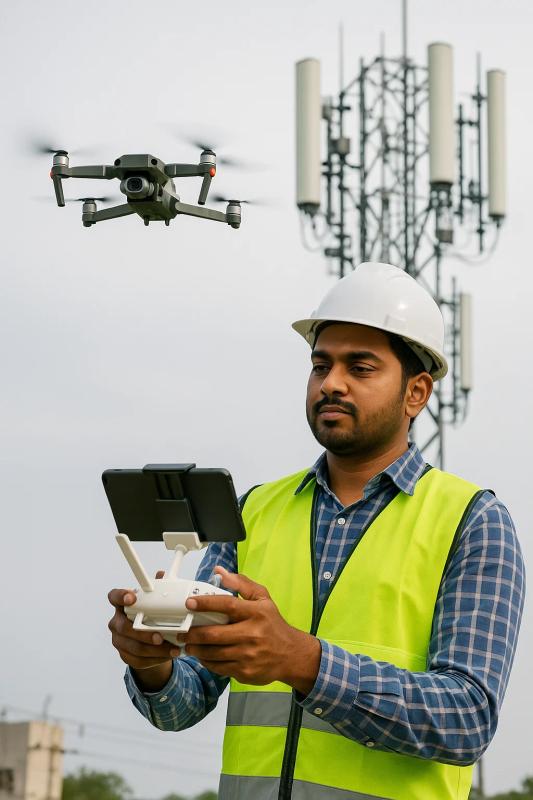
In 2024, a leading telecom provider in India faced a severe network disruption across four districts in Maharashtra.
Traditional tower inspections would’ve taken 4–5 days, risking millions in customer churn and service penalties. Instead, they deployed a trained UAV team that identified the issue within hours. Thanks to high-resolution thermal imagery and real-time diagnostics.
This success story highlights a growing shift in telecom operations. With networks expanding rapidly to accommodate 5G and IoT, telecom firms are turning to professionals with specialized UAV Course Certification India to maintain service continuity. These certified experts ensure inspections are faster, safer, and more cost-effective.
The Skill Gap in Telecom Maintenance
One of the pressing challenges telecom companies face is the shortage of professionals trained in modern UAV operations.
The ability to navigate drones around complex tower setups, capture high-resolution visuals, and assess maintenance needs without human risk is becoming a vital skill set.
More than just flying, it requires technical understanding, problem-solving abilities, and a trained eye for detecting faults in hardware and alignment.
As automation and remote monitoring become standard, telecom firms are increasingly seeking certified UAV operators who can deliver precision with accountability.
This demand has triggered a sharp rise in specialized drone training programs tailored to telecom applications.
Career Relevance of UAV Certification
A certified UAV operator is now more than just a technician. They are strategic contributors to operations, quality assurance, and infrastructure safety.
The rise of telecom towers in rural and urban regions alike has created a vast landscape for drone-based inspection.
Professionals who undergo structured training are far better equipped to meet industry standards and regulatory expectations.
Many telecom companies now mandate drone proficiency in their technician hiring processes, which reflects a broader industry-wide recognition of the value UAV skills bring.
Building the Right Foundation
While general drone piloting can be self-taught, industry-specific operations like those in telecom maintenance require a formal grounding. A UAV Course Certification provides this foundation, combining theoretical knowledge with practical, hands-on training.
The certification course typically covers drone navigation, data interpretation, safety protocols, airspace regulations, and practical exercises involving tower inspection simulations.
These modules are vital not only for compliance but also for ensuring drones are used to their fullest technical potential.
Why Telecom Prefers UAVs?
Drone technology reduces the physical risk to workers who would otherwise need to climb towers manually.
Beyond safety, UAVs enable quicker diagnosis, high-definition imaging, and real-time data relay; factors that directly influence uptime and network performance.
UAVs also make it feasible to conduct routine inspections in remote or geographically challenging areas without logistical complications.
Another advantage is the integration of UAV-collected data with AI analytics. Companies can build predictive models to assess equipment lifespan and anticipate failures, thus transitioning from reactive to preventive maintenance.
The telecom industry sees this as a massive cost and time advantage, further solidifying UAV skills as a non-negotiable asset.
The Main Role of Training Institutes in India
Institutes like the Indian Institute of Drone Technology play a pivotal role in bridging the skills gap. These organizations offer domain-specific training, including Drone Repair Courses in India, that are tailored for applications in telecommunications, agriculture, logistics, and security.
The benefit of enrolling in such programs is the immediate industry relevance. Graduates are job-ready, with a deep understanding of both drone tech and the context in which it’s applied.
This makes them valuable hires not just for telecom operators, but also for OEMs and third-party infrastructure audit agencies.
Industry Integration and Outlook
The adoption of drones in telecom is still evolving, but its trajectory is clear. Telecom maintenance teams are now integrating UAV units as standard practice, especially for high-rise structures and expansive network areas.
Drone operators work alongside field engineers, often feeding critical insights into network health that would be impossible or impractical to gather otherwise.
India aggressively expands its 5G and fiber optic networks, the reliance on smart infrastructure monitoring will only increase. Trained UAV professionals are poised to become long-term assets in this ecosystem.
Formal Credentials Are the Future
Aspiring UAV professionals must consider formal Drone Certification Courses from reputed institutions like Indian Institute of Drone Technology. These certifications offer the technical edge and industry alignment necessary to stand out in a competitive telecom job market.
Companies are no longer just looking for engineers. They are looking for UAV-equipped problem solvers who can ensure network reliability with minimal human risk.
Conclusion
The telecom industry is undergoing a quiet revolution, and drones are at its forefront. As infrastructure scales and complexity grows, UAV skills will not just be an advantage; they will be a baseline requirement. For professionals eyeing a future-proof career path, investing in drone education is no longer optional. It’s essential.

Post Your Ad Here
Comments