What is Inside an Electrical Control Panel? An Electrician Breaks It Down
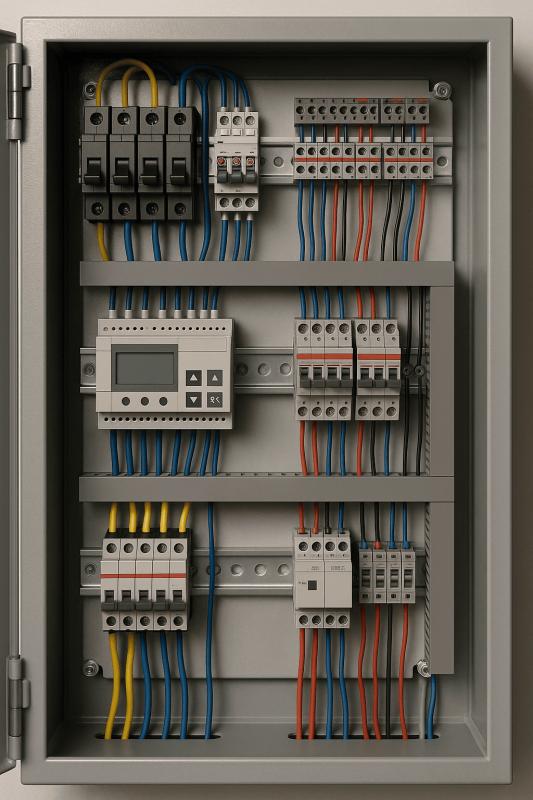
A Beginner-Friendly Look at the Brains Behind the Buttons
You’ve probably walked past one a hundred times without thinking twice. A gray metal box on the wall, sometimes humming quietly, maybe with a few warning labels on it. Boring? Not quite. That box is an electrical control panel—and inside is the command center for everything from your building’s lights and HVAC to conveyor belts, water pumps, or even an entire manufacturing line.
So what’s actually going on inside there? And why do electricians treat them like sacred ground?
Let’s pop the cover (safely, of course) and take a fun look inside an electrical control panel—with a little help from the pros who build and maintain them every day.
What Is an Electrical Control Panel, Exactly?
An electrical control panel is like the brain of a building’s electrical system. It takes power from the utility company and safely distributes it to machines, lights, outlets, or other control systems. But it doesn’t just deliver power—it manages it intelligently, monitors performance, and ensures everything is running as it should.
Think of it as a traffic cop, a brain, and a bodyguard all in one.
The Usual Suspects Inside the Panel
Let’s break down the most common components you’ll find inside a control panel—and what they actually do.
1. Main Breaker
“The main breaker is your emergency ‘off’ switch. Everything flows through here.”
– Mike, Licensed Electrician
The main breaker is the panel’s gatekeeper. It controls whether electricity is flowing into the panel at all. It’s also the quickest way to cut power in an emergency.
If a panel is the brain, the main breaker is the heartbeat. No pulse? Nothing else works.
2. Circuit Breakers
These guys are like bodyguards for each section of your system. Each breaker controls a specific circuit—lights, HVAC units, motors, etc.—and trips if there’s too much current. That’s a safety feature to prevent overheating, electrical fires, or damaged equipment.
They look like switches and are often labeled (hopefully correctly—looking at you, unlabeled panels from the 80s).
3. Contactors
“Contactors are like heavy-duty switches. When your system says ‘Go,’ they say ‘OK!’”
– Sarah, Industrial Controls Tech
Contactors are used to control high-power equipment. They’re like relay switches but built for serious loads. When a control signal comes in (like a thermostat saying “turn on the AC”), the contactor closes the circuit, and your equipment powers up.
They often make a loud clunk when they engage—totally normal.
4. PLCs (Programmable Logic Controllers)
This is where things get smart. A PLC is a small computer that controls sequences, timers, sensors, and logic functions.
Example: If Sensor A says “tank is full,” and Timer B says “wait 30 seconds,” and Button C is pushed—then start the motor. It’s all programmable, which means your electrician (or controls engineer) can fine-tune it to fit your exact needs.
“A PLC is the part that makes the magic happen behind the scenes.”
– Javier, Controls Electrician
5. Terminal Blocks & Wiring
Not glamorous, but absolutely critical. Terminal blocks are where wires connect to relay signals and power between components. Clean, organized wiring makes future troubleshooting easier—and a messy panel is a nightmare waiting to happen.
You’ll often hear electricians Idaho Falls brag about their panel wiring like artists showing off their brushstrokes.
6. Overload Relays, Sensors & Protection Devices
These components monitor temperature, current, and voltage levels. If a motor gets too hot or a system pulls too much power, these devices shut things down to prevent damage.
Basically, they’re the internal sensors that make sure your equipment doesn’t push its luck.
So Why Should You Care?
Even if you’re not an electrician, knowing what’s inside an electrical control panel gives you a better understanding of how your building or equipment works. It helps you ask smarter questions when something breaks and shows why regular maintenance isn’t just a “nice to have”—it’s essential.
And if you’re a facility manager or business owner, it might even help you spot warning signs before they become expensive problems.
Respect the Control Panel
Control panels are like the unsung heroes of modern infrastructure. They don’t get much spotlight, but they do the heavy lifting behind every machine, light, fan, and switch in the building.
The next time you walk past that gray box on the wall, give it a nod. Inside, it’s busy doing way more than you think.
Post Your Ad Here
Comments