Can Hologram Visualization Replace Traditional Displays
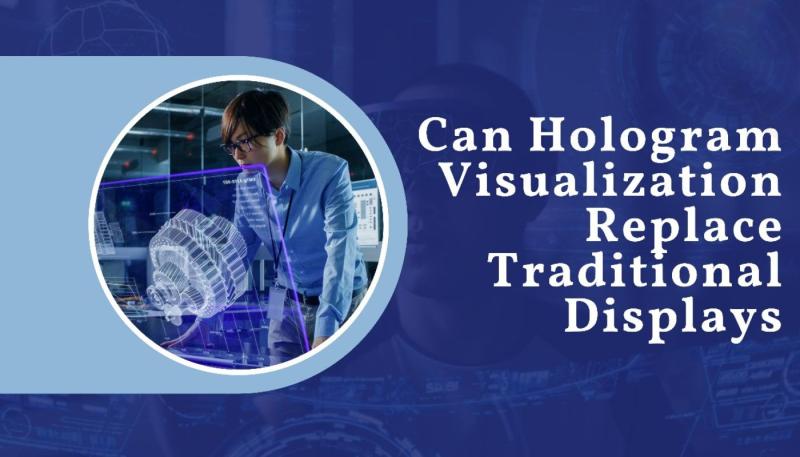
Hologram visualization is already on a rise and will further accelerate in 2025. Such a technology provides the opportunities for displaying the 3D images in the air, where digital contents can be visualized in a more real way. Many companies are now resorting to interactive methords such as incorporating interactive hologram, hologram screen and holographic display to have innovative methods of displaying and retrieving information. With improvement in these technologies, one even questions whether hologram visualization will replace the standard displays like television sets, computer screens as well as smartphones
Working of Hologram Visualization : Quick Overview
When it comes to the working of hologram visualization, there is the use of special types of screens and projectors that enable the imaging of three-dimensional (3D) images in space. However, they do not require one to wear a pair of glasses or a headset in order to view these graphics. Such an object allows you to move around it and examine it from different perspectives as you would a tangible object. This transforms the viewing experience as opposed to flat screen viewing.
Advantages Of Holographic Display Over Conventional Display
The following are some of the advantages of holographic display systems:
They produce genuine three dimensional images which are realistic and visible 360 degree.
And there are no funky wearables involved to ruin the visitors experience.
Hologram screens allow the content to be watched from any angle and not only from the center.
Interactive hologram systems allow you to manipulate images with your fingers or hands, which makes preparing reports and playing games interesting.
Images shown in Holographic displays will be clean flowing and without some problems of blurring in flat screen displays.
Application of Hologram Visualization in Various Sectors
There are countless applications of Hologram visualization in various sectors:
Entertainment and Gaming: Holographs help create concerts or games that put the audience in the heart of hot action. One can go online to watch a holographic concert or even play a game where the game characters come out of the screen and appear in front of the player.
Healthcare: Here, doctors make use of such holographic displays in viewing the organs’ 3-D structures or carrying out surgical alignment which minimizes the risks involved in the system and assures them of precision in their work.
Education: Teachers use interactive hologram to breakdown complex concepts. Learner tend to recycle and understand easier as they are allowed to touch and even view three dimensional objects.
Retail: In some shopping centers, hologram screen for product display is used. It allows customers to ‘handle’ a pair of shoes, some clothes or a gadget that is not on the shelves, but exists in the store.
Business: It is also used by different companies, which employ the use of holographic displays in their meetings and present threedimensional charts thus improving collaboration.
Limitations of Hologram Visualization
Despite all these positive aspects, there are few limitations associated with hologram visualization as follows:
Making large high quality holographic pictures can be difficult and expensive.
The devices used in this technology require very efficient processing units and special hardware which are expensive.
Many existing movies, games, applications, etc., are designed specifically for flat screens but would need completely new content to be able to work in holograms.
Most people find using conventional screens for most tasks fine and placement considerations do not favor holograms in each and every setting.
Recent Developments
Researchers have come up with new chipsets that enable the conversion of normal video images into three-dimensional holograms at a high speed and an optimized power consumption. Some firms are actually making holographic screens smaller and even cheaper, which may pave a way for embedding them in smart glasses and could soon be worn in other devices as well.
Can Hologram Visualization Displace Traditional Displays?
Most experts do not say that the hologram visualization will replace the existing screens entirely in the near future. Rather the two will be used in a complementary way. Holograms will be popular in settings such as schools, hospitals and traiditional retail establishments whereas flat panels will continue to dominate personal devices such as phones and laptops. With the evolution and reduction in cost of technology, such settings will include more use of holograms.
Wrap Up
The advancement of Hologram visualization agrees us to consum in a new manner digital contents. It enriches the experience in a very real, amusing, and engaging way. It may not quite enable the replacement of traditional displays yet, but it will function in parallel with them and enhance the digital environment.

Post Your Ad Here
Comments