Accurate Non Repaint Indicator
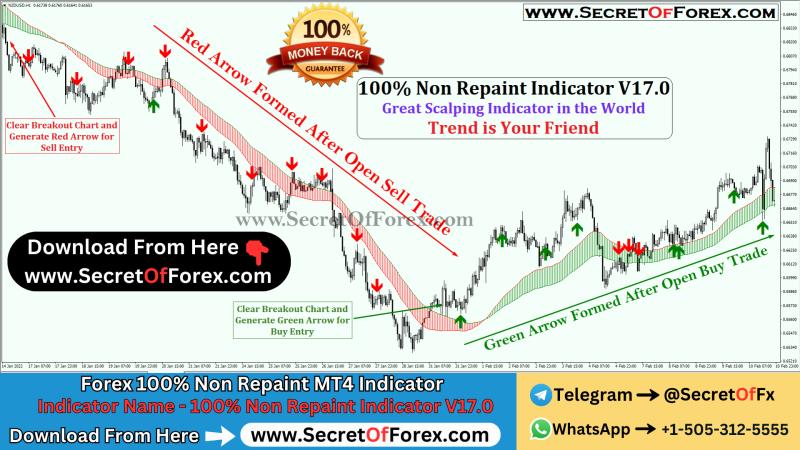
Finding an accurate non-repaint indicator in the realm of forex trading is a pursuit that many traders embark upon to enhance their trading strategies. Such indicators are valued for their ability to provide signals that remain stable and do not change after they have formed, unlike repainting indicators which can adjust their signals in hindsight. Here's a detailed exploration of what non-repaint indicators are, their importance, and considerations when choosing one.
Purchase this Powerful Indicator from here ??
Purchase Link - https://secretofforex.com/product/100-non-repaint-indicator-v17-0/
Contact Telegram - https://telegram.me/SecretOfFx
Contact WhatsApp - https://wa.me/+15053125555
Understanding Non-Repaint Indicators
Non-repaint indicators in forex trading refer to technical tools that generate signals based on past price action and market conditions. The key characteristic distinguishing them from repainting indicators is their signal stability. Once a non-repaint indicator generates a signal (buy or sell), it maintains that signal without recalculating or changing it in subsequent bars or candles on the chart.
Importance of Accuracy
Accuracy is paramount in forex trading, where decisions hinge on precise signals. Non-repaint indicators are sought after because they provide traders with reliable signals that reflect real-time market conditions. This reliability helps traders make informed decisions without the risk of false signals that can occur with repainting indicators.
Types of Non-Repaint Indicators
-
Moving Averages: Certain types of moving averages, such as exponential moving averages (EMA), can serve as non-repaint indicators when used in conjunction with other confirmation tools.
-
Support and Resistance Levels: Price levels that historically act as barriers to price movement can be used as non-repaint indicators when confirmed by volume or price action.
-
Oscillators: Oscillators like the Relative Strength Index (RSI) or Stochastic Oscillator can sometimes be adapted to provide non-repaint signals, though caution is needed in interpretation.
Choosing a Non-Repaint Indicator
When selecting a non-repaint indicator, several factors should be considered:
-
Historical Performance: Look for indicators with a proven track record of generating stable signals over various market conditions.
-
Compatibility with Strategy: Ensure the indicator aligns with your trading strategy and complements other tools you use, such as trend lines or Fibonacci retracements.
-
User Feedback: Reviews and feedback from other traders can provide insights into the indicator's reliability and effectiveness.
-
Customizability: Some non-repaint indicators offer options for customization, allowing traders to adjust parameters based on their preferences and market conditions.
Challenges and Considerations
Despite their advantages, non-repaint indicators aren't infallible. They may lag behind sudden market movements or fail to anticipate rapid changes in volatility. Traders should use them as part of a comprehensive trading strategy that includes risk management and continuous adaptation to market dynamics.
Conclusion
In conclusion, the quest for an accurate non-repaint indicator in forex trading involves understanding their characteristics, evaluating their reliability, and integrating them effectively into a trading strategy. While no indicator guarantees success, choosing a non-repaint indicator can significantly enhance decision-making by providing stable signals based on objective market data. By combining these tools with prudent risk management practices and ongoing market analysis, traders can improve their chances of achieving consistent profitability in the dynamic world of forex trading.

Comments