Day Trading Scalping Indicators MT4
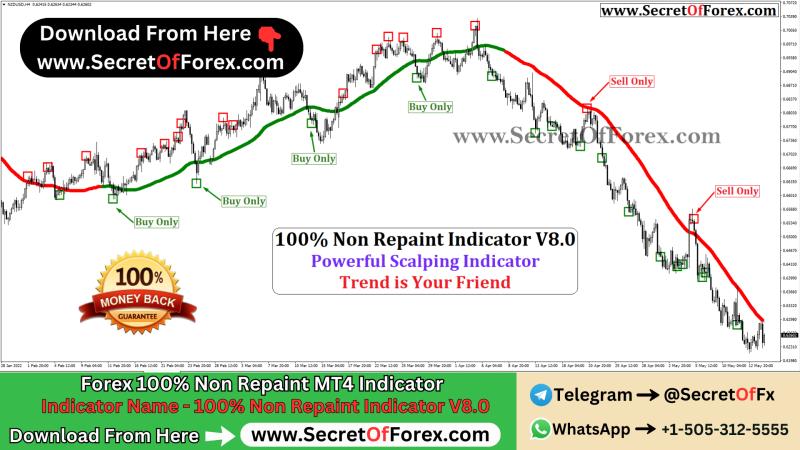
Day trading and scalping are intensive trading strategies that require quick decision-making and effective use of indicators to capitalize on short-term price movements. Here’s a concise guide on some key indicators for MT4 (MetaTrader 4) that are commonly used in day trading and scalping strategies:
Purchase this Powerful Indicator from here ??
Purchase Link - https://forexprostore.com/product/100-non-repaint-indicator-v8-0/
Contact Telegram - https://telegram.me/SecretOfFx
Contact WhatsApp - https://wa.me/+15053125555
-
Moving Averages (MA): These indicators smooth out price data to identify trends. For scalping, traders often use shorter period MAs like 5 or 10-period, while for day trading, longer MAs such as 50 or 100-period may be more suitable to gauge overall trends.
-
Relative Strength Index (RSI): RSI measures the magnitude of recent price changes to evaluate overbought or oversold conditions. Day traders often use RSI values above 70 to indicate overbought conditions and below 30 for oversold conditions.
-
Stochastic Oscillator: This indicator compares a closing price to its price range over a period, signaling potential reversal points. Traders look for crosses above 80 for overbought conditions and below 20 for oversold conditions.
-
Bollinger Bands: These consist of a moving average and two standard deviation lines above and below it. Traders use Bollinger Bands to identify volatility and potential price breakouts or reversals.
-
MACD (Moving Average Convergence Divergence): MACD shows the relationship between two moving averages and can signal changes in the strength, direction, momentum, and duration of a trend. Traders watch for MACD line crossovers and divergences from the signal line.
-
Volume Indicators: These show the amount of trading activity in a market during a given period. Volume can confirm price trends or signal potential reversals when combined with other indicators.
-
Fibonacci Retracement: While not an indicator in the traditional sense, Fibonacci levels are used to identify potential support and resistance levels based on the Fibonacci sequence. Traders use these levels to plan entry and exit points.
-
ADX (Average Directional Index): ADX quantifies the strength of a trend, with values above 25 indicating a strong trend and values below 20 suggesting a weak trend or ranging market.
-
Ichimoku Kinko Hyo: This indicator provides information on support and resistance levels, trend direction, and momentum in one glance. It consists of several lines that can help traders identify trends and reversals.
-
Pivot Points: These are calculated based on the previous day's high, low, and close to identify potential support and resistance levels for the current trading day.
In conclusion, successful day trading and scalping using MT4 involves selecting a combination of indicators that complement each other and align with your trading strategy. It's essential to understand each indicator's strengths and weaknesses and to practice using them in different market conditions to develop proficiency and consistency in trading decisions.
Post Your Ad Here
Comments