How Businesses Can Benefit from the Expanding Hologram Industry?
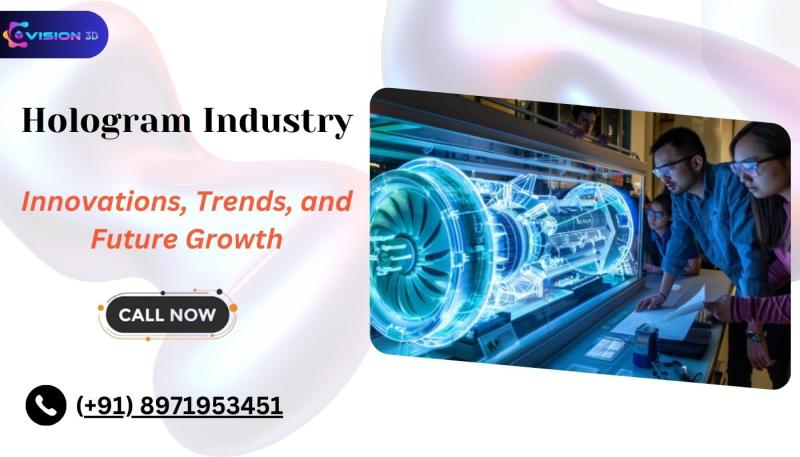
The hologram industry is about to experience a major overhaul, with expectations of tremendous growth in the near future. Companies are starting to realize the true potential of holographic technology, and they are looking for new ways to be creative with it in their respective industries. This article talks about ways that industries can take advantage of developments in the hologram industry while focusing on some key developments and applications that are working their way to the change of whole industries.
The Growing Hologram Industry – Quick Overview
As per current reports, the hologram market is expected to grow from $44.3 billion in 2024 to $47.52 billion in 2025, with a compound annual growth rate (CAGR) of 7.3%3. The growth, largely based on technological advancements, is coupled with a rising demand for immersive experiences on the part of industries. Companies engage in holographic displays, holographic glasses, and such novel products to engage customers and enhance operational efficiency.
Customer Engagement
The massive immersive marketing experience is one big benefit to be derived from the hologram industry. Businesses can make use of holographic equipment to create 3D displays of their products, inviting customers to engage with the items in a far more participative manner.
Interactive Product Displays: Holographic technology enables customers to view products from multiple angles without physical interaction, thus enhancing the shopping experience.
Personalized Marketing: In our case, where businesses will have personalized holograms in their marketing, they will "speak" to the individual consumer.
Innovative Advertising Campaigns
Companies like Coca-Cola have successfully used holographic technology within advertising campaigns and have thus gained an increase in consumer participation and brand awareness. Holographic glasses are usually distributed among the audience for special participation that impresses the audience and lingers in their minds.
Remote Collaboration
The hologram industry is also transforming communication within and outside companies. Latest advancements in holographic communication make it possible to conduct meetings in which all participants, present or distant, appear as 3D holograms. This advance promotes collaboration and strengthens the dynamics of the group.
Real-Time Holographic Calls: Offering an interactive experience beyond conventional video conferencing, businesses can give real-time holographic calls through 5G technology, whereby a doctor may study a 3D blood cell model that virtually pops out of his screen, a design plan for an architect, or even the display of bags available in one's store when consulting with clients located across continents online.
Training and Development: Why not use holograms in training? Employees can engage in lifelike simulations while improving their own learning outcomes.
Applications Across Industries
Medicine could be the most promising application areas of holography. The technology is being used in appointments and other advanced imaging techniques that help improve diagnostic accuracy and plan many different surgeries. For example, a doctor can see a complex circulatory system in three dimensions before removing the necessary tissue, resulting in better results in patient outcomes.
Enhanced Medical Training: Holograms will allow certain chapters in the lives of medical students owing to such lucid representationsof human anatomy that will only enable them to dig deeper into complex concepts.
Patient Communication: Whenever needed, we should give holographs to doctors so that they can explain ailments and treatments more effectively to their patients. In this regard, patient care overall soars.
Education and Training
In education, 3D holograms have proven beneficial in teaching complex subjects. Lessons are interactive and include holographic visuals making it easier for students to fully grasp difficult concepts.
Engaging Learning Environments: Holograms create interactive learning environments to engage the attention of students and increase retention.
Remote Learning Solutions: With such technology, we can adapt to the new age, moving into a more online space. Holographic technology will offer novel options in remotely engaging education, which may be fostered even more by technologies such as augmented reality (AR) and virtual reality (VR) for the full engagement of students.
Future Prospects of the Hologram Industry
Businesses should keep a close eye on new trends and technologies in the hologram industry, affecting the way they work. By extension, artificial Intelligence (AI) and holography integration will certainly bring about some exciting developments in real-time 3D visualization and interactive experiences. Companies must start investing in research and development to capture these advancements as soon as possible.
Key Trends to Watch
Across-the-Board Adoption: More sectors now believe in the benefit of holography. This directly points to probabilities of adoption in a myriad of trades such as retail, healthcare, education, etc., over the next few years.
Future Technological Improvements: Engineering, both hardware and software remain current and predictive for augmented quality and accessibility in holographic display.
High Customer Demand for an Immersive Experience: Customers want a 3D experience to engage in numerous hours of interaction with brands.
Conclusion!
Therefore growing holographic market is provided with some openings for novel businesses and maturing markets. Businesses that really use holographic technologies for marketing, communication, and education processes will experience an increase in customer engagement, improved efficiencies in operations, and growth.
Post Your Ad Here
Comments