Best Forex Indicator Mt4 For Day Trading
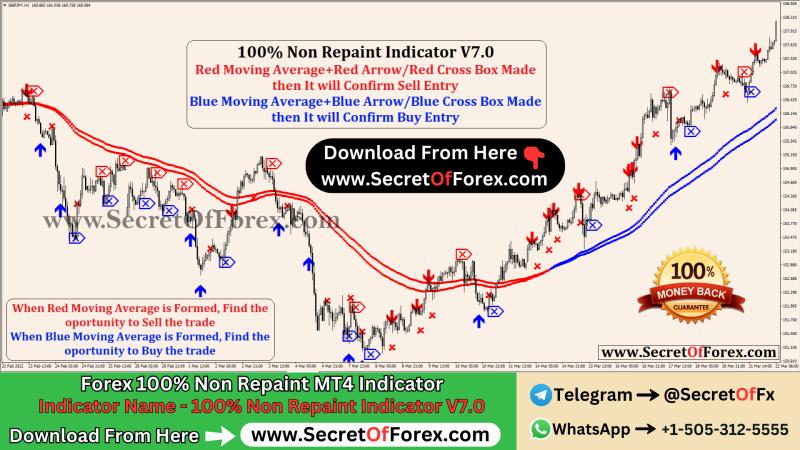
Choosing the best Forex indicators for day trading on MT4 can significantly enhance your trading strategy and decision-making process. Here’s a concise guide in 1000 words:
Purchase this Powerful Indicator from here ??
Purchase Link - https://forexprostore.com/product/100-non-repaint-indicator-v7-0/
Contact Telegram - https://telegram.me/SecretOfFx
Contact WhatsApp - https://wa.me/+15053125555
Introduction to Forex Indicators
Forex indicators are tools used by traders to analyze market behavior, identify trends, and make informed trading decisions. They are based on mathematical calculations and historical price data.
Types of Forex Indicators
-
Trend Following Indicators: These help traders identify the direction of the trend.
- Moving Averages (MA): Smooth out price data to identify trends over a specified period.
- Average Directional Index (ADX): Measures trend strength without regard to trend direction.
-
Oscillators: These indicate overbought or oversold conditions in the market.
- Relative Strength Index (RSI): Measures the speed and change of price movements.
- Stochastic Oscillator: Compares a closing price to its price range over a period.
-
Volume Indicators: Analyze trading volume to confirm trends and reversals.
- On-Balance Volume (OBV): Uses volume flow to predict changes in stock price.
- Accumulation/Distribution Line (A/D Line): Calculates the money flow in and out of a security.
-
Volatility Indicators: Measure the rate of price fluctuations.
- Average True Range (ATR): Measures market volatility over a specified period.
Choosing the Right Indicators for Day Trading
- Simplicity: Focus on a few key indicators that complement each other rather than overcrowding your charts.
- Relevance to Strategy: Select indicators that align with your trading strategy (e.g., trend following, range-bound).
- Customization: Adjust indicator settings to suit different market conditions and timeframes.
Best Forex Indicators for Day Trading on MT4
Moving Averages (MA)
- Simple Moving Average (SMA): Provides a straightforward average of prices over a defined period.
- Exponential Moving Average (EMA): Places more weight on recent prices, reacting faster to price changes.
Relative Strength Index (RSI)
- Purpose: Identifies overbought or oversold conditions.
- Application: Readings above 70 indicate overbought, while below 30 suggest oversold.
Bollinger Bands
- Purpose: Measures volatility and identifies overbought or oversold conditions.
- Components: Consist of a central SMA and upper/lower bands based on standard deviations from the SMA.
Average True Range (ATR)
- Purpose: Measures market volatility.
- Application: Helps set stop-loss levels and determine position size based on market conditions.
MACD (Moving Average Convergence Divergence)
- Purpose: Identifies changes in the strength, direction, momentum, and duration of a trend.
- Components: Consists of two moving averages (MACD line and signal line) and a histogram representing the difference between the two.
Implementing Indicators Effectively
- Confirm Signals: Use multiple indicators to confirm trading signals for higher accuracy.
- Avoid Overtrading: Wait for confluence among indicators before entering a trade.
- Adjust Periodicity: Adapt indicator settings (e.g., timeframe) to the market’s volatility and your trading style.
Conclusion
Choosing the best Forex indicators for day trading on MT4 involves understanding their purpose, application, and suitability to your trading strategy. Whether you prefer trend-following indicators like moving averages, oscillators like RSI, or volatility measures like ATR, each plays a crucial role in analyzing market dynamics and making informed trading decisions. By integrating these indicators effectively and aligning them with your strategy, you can enhance your trading performance and navigate the complexities of the Forex market with confidence.
Post Your Ad Here
Comments