Pest Control Market Size, Trends and Forecast 2024-2030
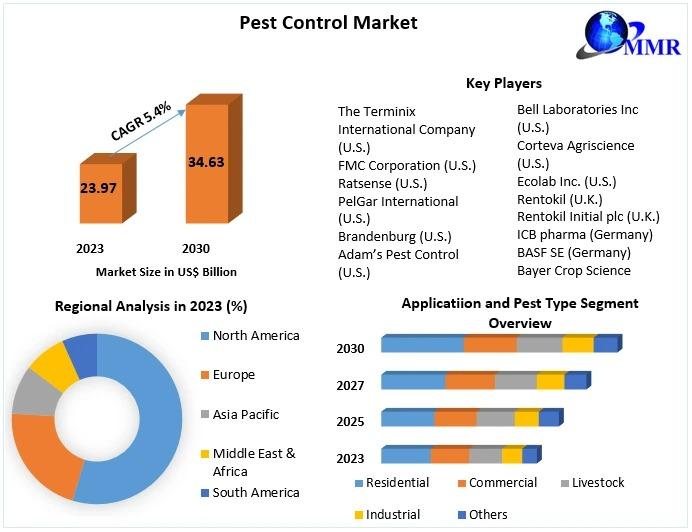
Pest Control Market Anticipated to Reach USD 34.63 Billion by 2030
The Pest Control Market size was valued at USD 23.97 Bn in 2023 and is expected to reach USD 34.63 Bn by 2030, at a CAGR of 5.4 %. This growth is driven by increasing consumer awareness of health and hygiene, the proliferation of vector-borne diseases, and a significant shift towards environmentally friendly pest management solutions.
Market Definition and Overview
Pest control involves the regulation and management of species classified as pests, which adversely affect human activities, structures, and health. These pests range from insects and rodents to other unwanted organisms that can cause damage to crops, property, and pose health risks. Effective pest control employs a combination of methods, including chemical, biological, and physical strategies, to mitigate and prevent pest infestations.
In recent years, there has been a notable transition towards Integrated Pest Management (IPM) practices. IPM emphasizes the use of comprehensive information on pest life cycles and their interaction with the environment, combining multiple control methods to minimize economic, health, and environmental risks. This approach reflects a broader societal move towards sustainable and ecologically responsible pest management practices.
Market Growth Drivers and Opportunities
Several key factors are propelling the expansion of the pest control market:
Increased Health and Hygiene Awareness: The global rise in health consciousness, especially in the wake of recent pandemics, has heightened the emphasis on maintaining sanitary environments. This awareness has led to a surge in demand for effective pest control services to prevent the spread of diseases and ensure safe living and working conditions.
Proliferation of Vector-Borne Diseases: The increasing incidence of diseases transmitted by pests, such as malaria, dengue, Lyme disease, and Zika virus, has underscored the necessity for robust pest control measures. Effective management of pest populations is crucial in mitigating the spread of these illnesses.
Environmental and Regulatory Pressures: Stringent environmental regulations and a growing consumer preference for eco-friendly products have prompted the pest control industry to innovate and develop sustainable solutions. This includes the adoption of biological control agents and reduced reliance on chemical pesticides.
Urbanization and Population Growth: Rapid urbanization and expanding population densities have led to increased waste generation and habitat modification, creating conducive environments for pests. This urban expansion necessitates comprehensive pest control services to manage and prevent infestations in residential and commercial areas.
Technological Advancements and Product Innovation: Continuous research and development efforts have resulted in advanced pest control technologies and products. Innovations such as smart pest monitoring systems, the use of drones for large-scale pest surveillance, and the development of targeted biopesticides offer more efficient and environmentally friendly pest management solutions.
Segmentation Analysis
The pest control market is segmented based on pest type, control method, application, and region.
By Pest Type:
- Insects: This category includes pests such as mosquitoes, bedbugs, cockroaches, and flies. The demand for insect control is driven by the need to prevent disease transmission and maintain hygiene standards in residential and commercial settings.
- Rodents: Rodent control addresses issues related to mice and rats, which can cause structural damage and pose health risks through contamination. Effective rodent management is essential in urban areas and food-related industries.
- Termites: Termites are known for causing significant structural damage to buildings and wooden structures. The termite control segment is experiencing growth due to increased awareness and preventive measures in construction and property maintenance.
- Wildlife: This segment encompasses the management of larger pests such as birds, raccoons, and squirrels. Wildlife control is crucial in preventing property damage and mitigating health risks associated with these animals.
By Control Method:
- Chemical Control: Involves the use of pesticides and insecticides to eliminate pests. While effective, there is a growing shift towards reduced chemical usage due to environmental and health concerns.
- Mechanical Control: Utilizes physical methods such as traps, barriers, and manual removal to manage pests. Mechanical control is often employed in conjunction with other methods for integrated pest management.
- Biological Control: Employs natural predators, parasites, or pathogens to control pest populations. This environmentally friendly approach is gaining traction as part of sustainable pest management practices.
By Application:
- Residential: Pest control services for homes and apartment complexes focus on eliminating common household pests to ensure safe and healthy living environments.
- Commercial: Encompasses pest management in businesses, offices, hotels, and retail establishments. Maintaining pest-free commercial spaces is vital for business reputation and compliance with health regulations.
- Industrial: Pertains to pest control in manufacturing plants, warehouses, and other industrial facilities. Effective pest management in these settings prevents contamination and protects products and equipment.
- Agricultural: Involves pest control in farming and crop production to protect yields and ensure food security. Sustainable agricultural pest management practices are essential for long-term productivity.
Country-Level Analysis
United States: The U.S. pest control market is experiencing growth due to heightened awareness of health and hygiene, coupled with the prevalence of vector-borne diseases. The adoption of Integrated Pest Management practices and demand for eco-friendly solutions are significant trends. However, recent reports indicate that companies like Rentokil Initial have faced challenges, including reduced demand for termite extermination services and a slowdown in the North American market, leading to profit warnings and strategic reassessments.
Germany: Germany's pest control market is characterized by stringent environmental regulations and a strong emphasis on sustainable practices. The demand for biological control methods and reduced chemical usage aligns with the country's commitment to environmental responsibility. The market is also influenced by urbanization and the need for pest management in densely populated areas.
Competitive Landscape
The pest control industry is highly competitive, with key players focusing on strategic acquisitions, service diversification, and technological innovation to enhance their market position. Notable companies include:
Rentokil Initial plc: A global leader in pest control services, Rentokil has expanded its presence through strategic acquisitions, including the purchase of Terminix in 2021. However, the company has recently faced challenges in the North American market, leading to profit warnings and a reevaluation of its operational strategies.
Terminix Global Holdings, Inc.: Acquired by Rentokil, Terminix is a prominent provider of residential and commercial pest control services. The integration of Terminix into Rentokil's operations aims to leverage combined expertise and expand service offerings.
Ecolab Inc.: Specializing in water, hygiene, and energy technologies, Ecolab offers comprehensive pest elimination services. The company's focus on sustainability and innovation positions it well in the evolving pest control market.
Rollins, Inc.: Known for its subsidiary, Orkin, Rollins provides essential pest control services across various sectors. The company's extensive network and commitment to customer service contribute to its strong market presence.
Anticimex: A Swedish pest control company emphasizing modern pest management solutions, Anticimex integrates digital technology and sustainable practices to deliver effective services.
Post Your Ad Here
Comments