Best Mt4 Indicator For Gold Trading
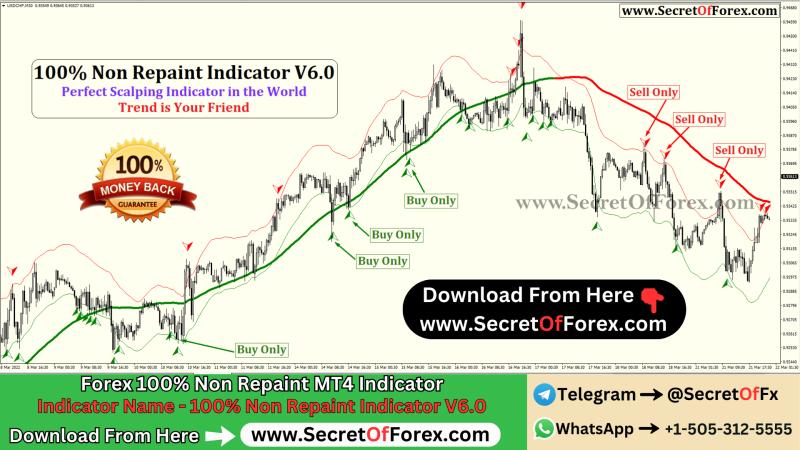
Best MT4 Indicators for Gold Trading
Trading gold (XAU/USD) on MetaTrader 4 (MT4) requires precision and the right set of tools. Gold is highly volatile and sensitive to economic data, making it essential to use reliable indicators that provide accurate signals. Below are the best MT4 indicators for gold trading and how to use them effectively.
Purchase this Powerful Indicator from here ??
Purchase Link - https://forexprostore.com/product/100-non-repaint-indicator-v6-0/
Contact Telegram - https://telegram.me/SecretOfFx
Contact WhatsApp - https://wa.me/+15053125555
1. Moving Average (MA)
Moving Averages help traders identify trends and potential reversal points. The most effective moving averages for gold trading include:
- Simple Moving Average (SMA): The 50-day and 200-day SMAs are widely used for trend identification.
- Exponential Moving Average (EMA): The 9-period and 21-period EMAs are useful for short-term trading strategies.
How to Use:
- A golden cross (short-term MA crossing above long-term MA) indicates a buy signal.
- A death cross (short-term MA crossing below long-term MA) indicates a sell signal.
2. Relative Strength Index (RSI)
The RSI is a momentum oscillator that measures the speed and change of price movements.
Settings:
- Standard setting: 14-period
- Overbought level: 70
- Oversold level: 30
How to Use:
- When RSI is above 70, gold is considered overbought (potential sell opportunity).
- When RSI is below 30, gold is considered oversold (potential buy opportunity).
3. Bollinger Bands
Bollinger Bands measure market volatility and identify overbought and oversold conditions.
Settings:
- Standard setting: 20-period SMA with 2 standard deviations
How to Use:
- When the price touches the upper band, it suggests overbought conditions.
- When the price touches the lower band, it suggests oversold conditions.
- A squeeze (bands narrowing) indicates upcoming volatility.
4. Fibonacci Retracement
Fibonacci retracement levels help identify key support and resistance levels.
Key Levels:
- 23.6%
- 38.2%
- 50%
- 61.8%
- 78.6%
How to Use:
- Traders look for price reactions at Fibonacci levels to identify potential entry and exit points.
- The 61.8% retracement level is often seen as a strong reversal zone.
5. MACD (Moving Average Convergence Divergence)
MACD is a trend-following indicator that helps traders determine bullish and bearish momentum.
Settings:
- Standard: 12, 26, 9
How to Use:
- A bullish crossover (MACD line crossing above the signal line) signals a buy opportunity.
- A bearish crossover (MACD line crossing below the signal line) signals a sell opportunity.
- A divergence between MACD and price action can indicate trend reversals.
6. Average True Range (ATR)
ATR measures market volatility and helps traders set stop-loss levels.
How to Use:
- A high ATR value indicates high volatility, suggesting wider stop-loss placement.
- A low ATR value indicates low volatility, suggesting tighter stop-loss placement.
7. Stochastic Oscillator
The stochastic oscillator helps identify overbought and oversold market conditions.
Settings:
- %K: 14
- %D: 3
How to Use:
- When the stochastic lines cross above 80, gold is overbought (potential sell signal).
- When the stochastic lines cross below 20, gold is oversold (potential buy signal).
- Bullish and bearish divergences between stochastic and price can signal reversals.
8. Volume Profile
Volume Profile helps traders identify price levels with high trading activity.
How to Use:
- High volume areas indicate strong support and resistance.
- Low volume areas suggest weak price levels where price may move quickly.
9. Ichimoku Cloud
The Ichimoku Cloud is a comprehensive indicator that provides trend direction, support/resistance levels, and momentum.
Components:
- Tenkan-sen (9-period average)
- Kijun-sen (26-period average)
- Senkou Span A & B (leading spans forming the cloud)
- Chikou Span (lagging indicator)
How to Use:
- If the price is above the cloud, the trend is bullish.
- If the price is below the cloud, the trend is bearish.
- The cloud acts as dynamic support and resistance.
10. Pivot Points
Pivot Points help traders identify potential turning points in the market.
How to Use:
- The pivot level acts as a key price level.
- Support 1, Support 2, and Support 3 indicate possible buying zones.
- Resistance 1, Resistance 2, and Resistance 3 indicate possible selling zones.
Conclusion
Choosing the right indicators for gold trading on MT4 depends on your trading style and market conditions. A combination of trend, momentum, volatility, and support/resistance indicators can improve your trading accuracy. Testing different indicators and refining your strategy will help you make more informed trading decisions in the gold market.
Post Your Ad Here
Comments