Best Technical Indicators For Day Trading Indicator
Best Technical Indicators for Day Trading
Day trading is a fast-paced trading style that requires quick decision-making based on technical indicators. Traders use these indicators to analyze price movements, identify trends, and determine entry and exit points. In this guide, we’ll discuss some of the best technical indicators for day trading, how they work, and how to use them effectively.
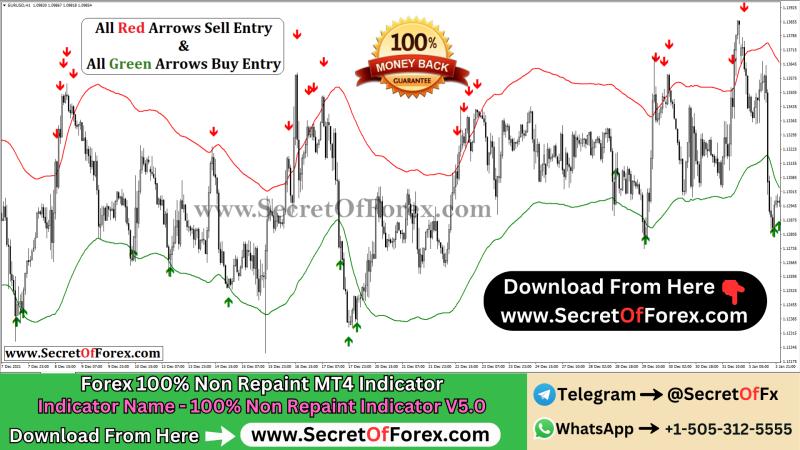
Purchase this Powerful Indicator from here ??
Purchase Link - https://forexprostore.com/product/100-non-repaint-indicator-v5-0/
Contact Telegram - https://telegram.me/SecretOfFx
Contact WhatsApp - https://wa.me/+15053125555
1. Moving Averages (MA)
What is it?
A moving average (MA) smooths out price data to identify the overall trend direction. It is one of the most widely used indicators in day trading.
Types of Moving Averages:
- Simple Moving Average (SMA): Calculates the average price over a set period.
- Exponential Moving Average (EMA): Gives more weight to recent prices, making it more responsive to price changes.
How to Use:
- Trend Identification: If the price is above the moving average, the trend is bullish. If it's below, the trend is bearish.
- Golden Cross & Death Cross: When a short-term MA crosses above a long-term MA, it’s a bullish signal (Golden Cross). If it crosses below, it’s bearish (Death Cross).
- Dynamic Support and Resistance: The moving average can act as a support or resistance level.
2. Relative Strength Index (RSI)
What is it?
RSI is a momentum oscillator that measures the speed and change of price movements on a scale of 0 to 100.
How to Use:
- Overbought & Oversold Levels: RSI above 70 indicates overbought conditions (possible reversal), while below 30 indicates oversold conditions (potential buying opportunity).
- Divergence: If the price is making a new high, but RSI is not, it could indicate a reversal.
3. Moving Average Convergence Divergence (MACD)
What is it?
MACD is a trend-following momentum indicator that shows the relationship between two moving averages.
Components of MACD:
- MACD Line: Difference between the 12-period EMA and the 26-period EMA.
- Signal Line: 9-period EMA of the MACD line.
- Histogram: Represents the difference between the MACD and Signal Line.
How to Use:
- Crossover Strategy: When the MACD line crosses above the signal line, it’s a buy signal; when it crosses below, it’s a sell signal.
- Divergence: If the price is making higher highs, but MACD is making lower highs, it signals a potential reversal.
4. Bollinger Bands
What is it?
Bollinger Bands consist of a middle SMA, an upper band, and a lower band. The bands expand and contract based on market volatility.
How to Use:
- Breakouts: When price moves outside the bands, it signals high volatility and potential trend continuation or reversal.
- Squeeze Strategy: When bands tighten, it indicates low volatility, often preceding a breakout.
5. Volume Weighted Average Price (VWAP)
What is it?
VWAP is a trading benchmark that gives the average price a security has traded at throughout the day, weighted by volume.
How to Use:
- Trend Confirmation: If the price is above VWAP, it indicates a bullish trend; below VWAP signals a bearish trend.
- Support & Resistance: VWAP acts as an intraday support or resistance level.
6. Stochastic Oscillator
What is it?
The Stochastic Oscillator compares a security's closing price to its price range over a specific period to gauge momentum.
How to Use:
- Overbought & Oversold Conditions: Above 80 is overbought, below 20 is oversold.
- Bullish & Bearish Crosses: When the %K line crosses above the %D line, it signals a buy; when it crosses below, it signals a sell.
7. Fibonacci Retracement
What is it?
Fibonacci retracement is a tool used to identify potential support and resistance levels based on key Fibonacci ratios (23.6%, 38.2%, 50%, 61.8%).
How to Use:
- Support & Resistance Levels: Price tends to reverse at Fibonacci levels, making them ideal for setting stop-loss and take-profit points.
- Trend Reversals: If the price retraces to a Fibonacci level and shows reversal signs, it could be a good entry point.
8. Average True Range (ATR)
What is it?
ATR measures market volatility by calculating the average range between high and low prices over a set period.
How to Use:
- Volatility Measurement: Higher ATR values indicate higher volatility, while lower values suggest a calmer market.
- Stop-Loss Placement: Traders use ATR to determine optimal stop-loss levels.
9. Parabolic SAR (Stop and Reverse)
What is it?
Parabolic SAR helps traders identify trend direction and reversals by plotting dots above or below price movements.
How to Use:
- Trend Direction: When dots are below the price, it indicates an uptrend; when above, it signals a downtrend.
- Entry & Exit Points: SAR dots switching positions suggest potential trend reversals.
10. Ichimoku Cloud
What is it?
Ichimoku Cloud is a comprehensive indicator that defines support, resistance, momentum, and trend direction.
Components of Ichimoku Cloud:
- Tenkan-sen (Conversion Line)
- Kijun-sen (Base Line)
- Senkou Span A & B (Cloud boundaries)
- Chikou Span (Lagging Line)
How to Use:
- Bullish & Bearish Signals: Price above the cloud indicates a bullish trend, below suggests a bearish trend.
- Kumo Breakouts: When price breaks above or below the cloud, it signals potential trend continuation.
Choosing the Right Indicator for Day Trading
While each of these indicators is powerful, traders should avoid using too many at once. Instead, consider the following combinations:
- Trend-Following Strategy: Moving Averages + MACD + Parabolic SAR
- Momentum Strategy: RSI + Stochastic Oscillator + MACD
- Volatility Strategy: Bollinger Bands + ATR + VWAP
- Support & Resistance Strategy: Fibonacci Retracement + Moving Averages + Ichimoku Cloud
Conclusion
Technical indicators play a crucial role in day trading by helping traders make informed decisions. The key to success is understanding how each indicator works and combining them effectively based on market conditions. By mastering a few reliable indicators and testing them in a demo account, traders can develop a winning strategy for consistent profits in the fast-moving world of day trading.
Post Your Ad Here
Comments