Accurate non repaint indicator
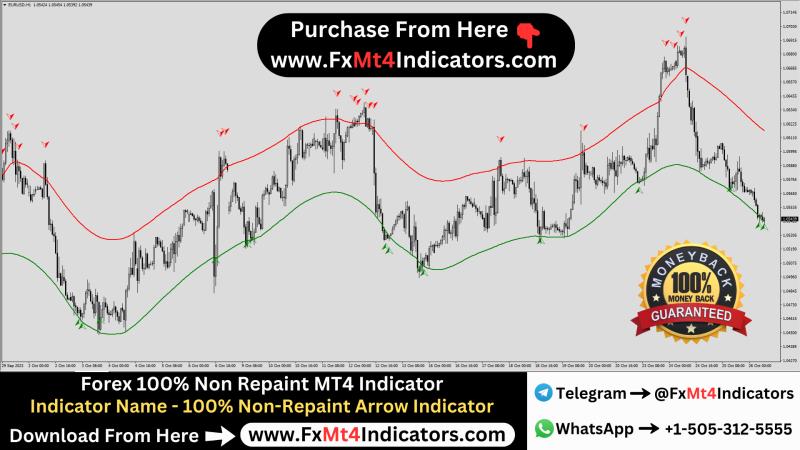
Creating an accurate, non-repaint indicator is a complex task that involves understanding both technical analysis and programming principles.
Purchase this Powerful Indicator from here ?
Purchase Link - https://forexprostore.com/product/100-non-repaint-arrow-indicator/
Contact Telegram - https://telegram.me/SecretOfFx
Contact WhatsApp - https://wa.me/+15053125555
Introduction to Indicators
Indicators in trading are tools used to analyze price movements and forecast future trends. They are derived from mathematical calculations applied to historical price data. The goal is to identify patterns or trends that can help traders make informed decisions about buying or selling assets.
Types of Indicators
There are two main types of indicators: leading and lagging.
-
Leading indicators attempt to predict price movements before they occur. Examples include oscillators like the Relative Strength Index (RSI) and the Stochastic Oscillator.
-
Lagging indicators follow price movements and provide signals after the trend has started. Moving averages are classic examples of lagging indicators.
Challenges of Repainting Indicators
Repainting occurs when an indicator changes its signals after price movements have already occurred, making historical analysis misleading. This issue arises because some indicators recalculate their values based on future data, which is not available during real-time trading. Traders often seek non-repainting indicators for more reliable signals.
Principles of Non-Repainting Indicators
-
Data Integrity: Non-repainting indicators maintain consistency by not recalculating historical data based on future price movements.
-
Signal Stability: Signals generated by non-repainting indicators remain unchanged once generated, providing reliable entry and exit points.
-
Algorithm Complexity: Creating non-repainting indicators requires sophisticated algorithms that accurately reflect market conditions without hindsight bias.
Technical Components
Mathematical Formulas
Non-repainting indicators use robust mathematical formulas that ensure signal stability. These formulas are designed to process historical data without altering past signals.
Data Processing Techniques
Advanced data processing techniques, such as advanced statistical analysis and machine learning algorithms, help in creating indicators that adapt to market changes while maintaining non-repainting characteristics.
Indicator Development Process
-
Research and Planning: Identify the trading strategy and market conditions the indicator will address. Define criteria for signal generation and confirmation.
-
Algorithm Design: Develop mathematical formulas and algorithms based on technical analysis principles. Ensure the algorithm's efficiency and accuracy.
-
Backtesting: Test the indicator on historical data to validate its performance and verify non-repainting characteristics. Adjust parameters for optimal results.
-
Optimization: Fine-tune the indicator's parameters to improve signal accuracy and reduce false signals. Consider market volatility and trading preferences.
-
Validation: Conduct forward testing in real-time market conditions to confirm the indicator's reliability and adherence to non-repainting principles.
Practical Applications
Non-repainting indicators are widely used in various trading strategies:
- Trend Following: Identifying and confirming trends without changing historical signals.
- Volatility Measurement: Assessing market volatility to adjust trading strategies accordingly.
- Risk Management: Integrating non-repainting indicators into risk management frameworks to enhance trading decisions.
Conclusion
Developing an accurate, non-repainting indicator involves a rigorous process of algorithm design, testing, and validation. By adhering to technical analysis principles and leveraging advanced data processing techniques, developers can create indicators that provide stable and reliable signals for traders. These indicators contribute to informed decision-making, enhance trading strategies, and mitigate risks associated with market volatility.
Post Your Ad Here
Comments