Holographic Devices in Healthcare: Transforming Medical Imaging.
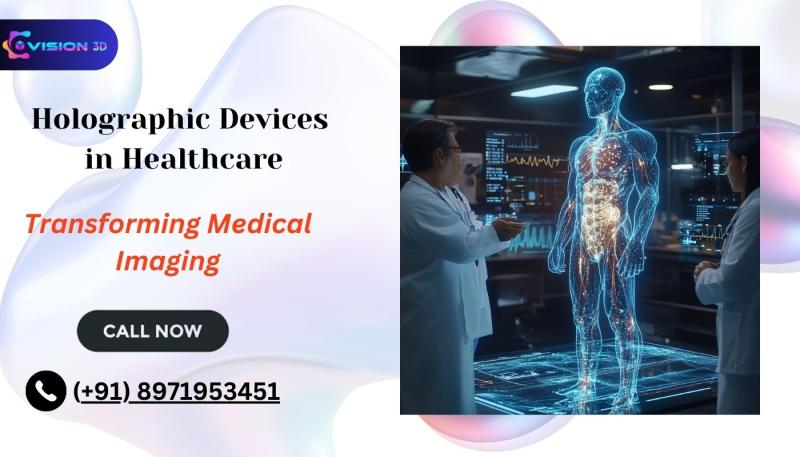
Holographic devices are revolutionizing the healthcare industry in medical imaging. Such equipment allows for more advanced surgery planning and better professional health training. Modern innovation has been moved to capture very high-quality images of the human body which are also dynamic. This article aims to analyze the effect of holographic devices on medical imaging and the benefits of these devices.
The Healthcare Revolution: The Use of Holographs in Medicine
The process of holography involves the reproduction of objects in three dimensions using lasers. In medicine there has been a progression in the use of this technology over the last few decades. Holographic devices do not appear to create 3D images like ordinary glasses that are 2D and adjusted with nearsighted glasses, or are one extinct – 3D glasses plus vision correction, but with the eyes of research experience. This actually makes it a little more realistic in these patient mannequins.
Development of Skills in Medicine
Holographic devices are used to teach medicine. They allow the creation of realistic images of human parts. As a result, students become better in complex topics. Attraction takes the learners away from boredom and traps them in the frame.
VR: Toward A 3D Module: Holography of organs & systems including pre-operative studies Holography could be successfully integrated into VR community making the professors to be where they want and have to be.
Attention: A Holographic device like a 3D hologram table is capable of creating high-resolution images for training, which particularly caters to students who cannot access physical evidence or specimens.
Holograms in the Institutions of Learning
As regards to the use of 3D hologram walls in educational institutions, they provide many learning arrangements. These are the innovations in the world of learning that will enhance the quality of learning and build interest.
Benefits of Advancement to Diagnostics with Modern Imaging Approaches
Holographic devices enhanced diagnostics short of CT or MR scanners. They allow each doctor to construct specific models of patients in order to visualize organs and tissues. It’s harder than it looks but it’s a lot more useful than 2D images because these holograms can be turned in all directions.
Hologram Scanner
A Hologram scanner makes it possible for physicians to convert 2D images into 3D models, which is essential in cases where internal organs or tissues are examined.
Interventions that Use Images
Holography helps in providing accurate anatomical images. It is applicable in procedures such as image-guided cardiac ablation. Basically, it helps doctors to visualize some objects that cannot be seen very clearly otherwise.
Preparation for Surgery and Conducting Surgery
In this surgery, doctors are assisted by the use of scopes in performing very little cutting on an organ. They are able to see the inside in three dimensions which reduces the degree of error and increases self and assurance during the operation.
Holographic Systems: Phase of Imaging Techniques and Benefits of Holograms
Holographic Images: Holographic images are used in surgical procedures to create images that have been enhanced for a clearer view.
Holographic Style of Endoscope and Microscope
This is a type of holography that is used in endoscopy and microscopy where light interference is used to form an image that is very detailed. It is fundamental in the medical discipline, especially where deeper areas of the body have to be viewed without the need to expose the patient.
Trends and Possibilities of Holographic Imaging in the World
Compatible with new technologies: The Possibilities of AI Going Beyond Conventional Image Processing. AI and holography will be used together for better efficiency resulting in a great boost within the medical field in interventional treatments.
Advanced Medical Holography: Medical holography is a more mature field, with newer techniques on the horizon.
For instance, such approaches may result in the usage of holograms that do not require waiting for refinement in the imaging process, as it would be used more efficiently in the medical field.
Wrap Up!
The development of devices such as hologram stage and hologram table promises a new paradigm of change within the field of medical imaging in visualizing, diagnosing, and learning. Such progress will aid in various types of medical care delivery enhancement and professional practice modification within the healthcare sector. Virtual holography should be adopted by every one of us in order to create a better and more precise health care system.
Post Your Ad Here
Comments