200-105 Certification Score
Test Information:
Total Questions 228
Test Number: 200-105
Vendor Name: CISCO
Cert Name :. CCNA
Test Name: Interconnecting Cisco Networking Devices Part 2 (ICND2 v3.0)
Official Site: http://www.examsboost.com
For More Details: https://www.examsboost.com/test/200-105/Question: 1
Which statement about QoS default behavior is true?
A. Ports are untrusted by default.
B. VoIP traffic is passed without being tagged.
C. Video traffic is passed with a well-known DSCP value of 46.
D. Packets are classified internally with an environment.
E. Packets that arrive with a tag are untagged at the edge of an administrative domain.
Answer: E
Frames received from users in the administratively-defined VLANs are classified or tagged for transmission to other devices. Based on rules that you define, a unique identifier (the tag) is inserted in each frame header before it is forwarded. The tag is examined and understood by each device before any broadcasts or transmissions to other switches, routers, or end stations. When the frame reaches the last switch or router, the tag is removed before the frame is sent to the target end station. VLANs that are assigned on trunk or access ports without identification or a tag are called native or untagged frames.
For IEEE 802.1Q frames with tag information, the priority value from the header frame is used. For native frames, the default priority of the input port is used.
Each port on the switch has a single receive queue buffer (the ingress port) for incoming traffic. When an untagged frame arrives, it is assigned the value of the port as its port default priority. You assign this value by using the CLI or CMS. A tagged frame continues to use its assigned CoS value when it passes through the ingress port.
Question: 2
Refer to the exhibit.
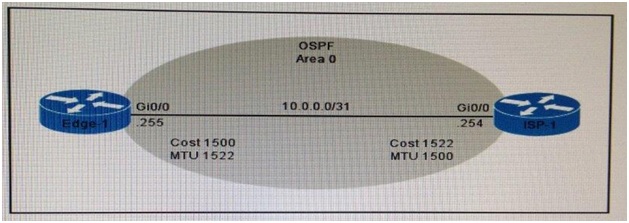
Router edge-1 is unable to establish OSPF neighbor adjacency with router ISP-1. Which two configuration changes can you make on edge-1 to allow the two routers to establish adjacency? (Choose two.)
A. Set the subnet mask on edge-1 to 255 255.255.252.
B. Reduce the MTU on edge-1 to 1514.
C. Set the OSPF cost on edge-1 to 1522.
D. Reduce the MTU on edge-1 to 1500.
E. Configure the ip ospf mtu-ignore command on the edge-1 Gi0/0 interface.
Answer: D, E
A situation can occur where the interface MTU is at a high value, for example 9000, while the real value of the size of packets that can be forwarded over this interface is 1500.
If there is a mismatch on MTU on both sides of the link where OSPF runs, then the OSPF adjacency will not form because the MTU value is carried in the Database Description (DBD) packets and checked on the other side.
Question: 3
Which statement about MPLS is true?
A. It operates in Layer 1.
B. It operates between Layer 2 and Layer 3.
C. It operates in Layer 3.
D. it operates in Layer 2.
Answer: B
MPLS belongs to the family of packet-switched networks. MPLS operates at a layer that is generally considered to lie between traditional definitions of OSI Layer 2 (data link layer) and Layer 3 (network layer), and thus is often referred to as a layer 2.5 protocol.
Post Your Ad Here
Comments