NASA spots scorching Earth-like planet
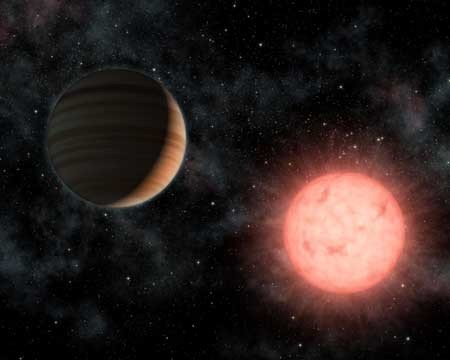

This NASA artist's concept shows the smallest star known to host a planet. The planet, called VB 10b, was discovered using astrometry. The dim, red star, called VB 10, is a so-called M-dwarf, located 20 light-years away in the constellation Aquila. The smallest-ever planet outside our solar system has been spotted by NASA's Kepler space telescope - a rocky planet similar in size to the Earth, the US space agency said Monday. Photo: AFP
NASA has spotted a tiny, rocky planet, about the size of Earth, doing a speedy orbit of a star outside our solar system, but its scorching temperatures are too hot for life, the space agency said Monday.
The exoplanet, named Kepler-10b, is the smallest-ever planet discovered outside our solar system, and was located by NASA's Kepler spacecraft.
It is about 1.4 times the size of Earth and spins around its star more than once a day, an orbit much too close for life to survive.
"Kepler-10b is definitely NOT in the habitable zone, as we define it. The dayside temperature of the planet is expected to be higher than 2,500 F (1,371 C)!!" NASA expert Natalie Batalha said in a Web chat to describe the discovery.
NASA defines the habitable zone, in part, to have a temperature below the boiling point of water and higher than the freezing point.
"That's hot enough to melt iron!" she added. "It wouldn't be a very nice place for organisms like those on Earth to live. Carbon-based chemistry wouldn't thrive there. Molecules comprising RNA and DNA couldn't stay intact in such extreme temperatures."
The planet completes a full orbit once every 0.84 days, and it is 23 times closer to its star than Mercury is to our sun.
According to Douglas Hudgins, a Kepler program scientist at NASA, the discovery is promising, even though no life could exist there.
"The discovery of Kepler 10-b is a significant milestone in the search for planets similar to our own," Hudgins said.
"Although this planet is not in the habitable zone, the exciting find showcases the kinds of discoveries made possible by the mission and the promise of many more to come," he said.
The new planet has a mass 4.6 times that of the Earth, and an average density of 8.8 grams per cubic centimeter, similar to an iron dumbbell, NASA said.
Kepler is NASA's first mission in search of Earth-like planets orbiting suns similar to ours.
It launched in 2009, equipped with the largest camera ever sent into space - a 95-megapixel array of charge-coupled devices - and is expected to continue sending information back to Earth until at least November 2012.
The space telescope is searching for planets as small as Earth, including those orbiting stars in a warm, habitable zone where liquid water could exist on the surface of the planet.

Comments