Islands In Malaysia
Like a giant sleeping dragon, the dark green ridges of Tioman Island rise up above the waters of the South China Sea. On closer inspection, it becomes clear that the dragon?s dark green scales are in fact giant trees and impenetrable jungle; that the grey claws are giant granite boulders and that the dragon?s horns are twin peaks with smooth, straight cliffs, surrounded with swirls of mist.
The dragon-like appearance of Tioman Island is at the root of a legend surrounding its origin: A dragon princess from China was flying to her prince in Singapore and stopped to rest in these calm, warm waters. Enamoured by the beauty of the area, and the waves lapping at her sides, she discontinued her journey and took the form of an island.
The natural beauty of the island is its biggest attraction. Lush tropical jungle covers about 12,000 hectares of the island and countless mountain streams and waterfalls sustain the many protected species of mammals and birds. The waters around the island are filled with corals of all shapes and colours and home to a vast diversity of sea creatures, including two species of marine turtle. There are a few excellent beaches on Tioman, and these curves of golden sand are usually tucked away at the edges of villages or fronting one of the many resorts.
Tioman has options for every kind of holiday-maker: families with small children, honeymooners, scuba divers, backpackers, adventurers and even those looking for a slice of exclusivity and luxury. Most places to stay are clustered around the villages that are dotted along Tioman?s coastline while there are a few small resorts that are built around private beach coves.
Tioman is the largest in a volcanic group of islands off the east coast of peninsular Malaysia. Getting there is simple as there is both a ferry service from Mersing on the mainland and an airport on the island itself.
Tioman is a beautiful, popular and affordable holiday destination so book ahead!
Pangkor Island

Off the coast of perak State, north of Selangor , lies a cluster of fabulous islands with unquestionably some of the best coves and beaches on the western coast of peninsular Malaysia. Among them, two islands predominate in terms of accessibility, infrastructure and development - the largest island, Pangkor and her sister Pangkor Laut. Those who are not familiar with the geographical locations generally confuse the two.
Forty minutes by ferry from Lumut, the popular island resort of Pulau Pangkor (Pangkor Island) welcomes visitors with its serene golden beaches, crystalline blue waters, and cool refreshing breezes. Located about 90km south west of lpoh, it is largely inhabited by fisherfolk.
They live in scattered fishing settlements along the coast especially on the eastern side, facing the town of Lumut and Teluk Batik, and their catch comprises mainly cuttlefish and anchovy. The modern facilities make it an ideal gateway. A wide range of sun and sea activities are available such as scuba diving, wind-surfing, fishing, snorkelling.
Terumbu Layang-layang Island
Terumbu Layang Layang, 'Swallow Reef' on Admiralty charts, is an isolated submerged coral atoll in the South China Sea, 306km northwest of Sabah's capital Kota Kinabalu. It has a man-made island covering 6 hectares situated on the eastern end of the atoll.
It is uncertain, whether this is an oceanic island formed by coral growth capping an extinct undersea volcano or a sunken mountain. Specialists believe that thirteen coral reefs linked up to form the 7.3km long, 2.2km wide atoll. The 20m deep enclosed lagoon, with its fixed mooring buoys, is the only safe anchorage in this remote region.
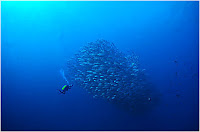
The reefs are pristine and the visibility excellent. Steep walls over extremely deep water provide spectacular diving. Resident shoals of barracuda and caranx are becoming accustomed to divers, while dolphins occasionally interact with them. Hawksbill and Green turtles are frequently seen resting on the reefs. Healthy corals are plentiful, sea fans exceeding three metres across filter planktonic food from the passing currents and yellow, red and purple soft tree corals grow to two
metres or more across in deeper water.
Set in a vast open sea, the reef attracts pelagic species, barracuda and Bigeye Trevally occur in large shoals and Oceanic Triggerfish arrive to nest in the warmer months. The northeast corner is a unique location where encounters with large shoals of Hammerhead Sharks are common when the water is colder during the months of April and May. On numerous occasions hundreds of these shy creatures are seen but they always keep just a little too far away for cameras to record clearly. One is only likely to have close encounters when small groups of them approach the reef while stalking Bigeye Trevally into shallow water.
On land, with more sand permanently exposed than on other islands in this large area, the atoll is a favoured nesting side for many species of migratory sea birds. There is a seasonal increase in numbers during the nesting months from February to October, when Brown Boobies, the commonest of the tropical gannets, with Noddies and Great Crested-Terns compete for space in raucous colonies. When alarmed the adults take off leaving well camouflaged eggs or chicks strewn everywhere. Tireless fliers, terns are often called 'Sea Swallows' because of their forked tails, hence the reef's name 'Swallow Reef'.

Post Your Ad Here
Comments (1)
Rosetta slmn7
content writer
What a beautiful Islands !
Thanks Ehsan for that and I hope I can Visit Malaysia one day .