Understanding Breast Cancer - the Basics
What Is Breast Cancer?
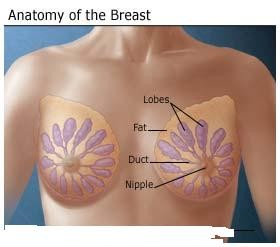
Before discussing breast cancer, it's important to be familiar with the anatomy of the breast. The normal breast consists of milk-producing glands that are connected to the surface of the skin at the nipple by narrow ducts. The glands and ducts are supported by connective tissue made up of fat and fibrous material. Blood vessels, nerves, and channels to the lymph nodes make up most of the rest of the breast tissue. All the breast anatomy mentioned above sits under the skin, but on top of the chest muscles.
As in all forms of cancer, the abnormal tissue that makes up breast cancer is the patient's own cells that have multiplied uncontrollably. Those cells may also travel to locations in the body where they are not normally needed, which means the cancer is malignant.
Breast cancer develops in the breast tissue, primarily in the milk ducts (ductal carcinoma) or glands (lobular carcinoma). The cancer is still called and treated as breast cancer even if it is first discovered after traveling to other areas of the body such as the lungs, liver, or bones. In those cases, the cancer is referred to as metastatic or advanced breast cancer.
Breast cancer usually begins with the formation of a small, confined tumor (lump), or as calcium deposits (microcalcifications) and then spreads through channels to the lymph nodes or through the blood stream to other organs. The tumor may also grow and invade tissue around the breast, such as the skin or chest wall. Different types of breast cancer grow and spread at different rates - some take years to spread beyond the breast while other move quickly.
Some lumps are benign (not cancerous), however these can be premalignant. The only safe way to distinguish between a benign lump and cancer is to have the tissue examined by a doctor.
Men can get breast cancer, too, but they account for less than one-half of one percent of all cases. Among women, breast cancer is the most common cancer and the second leading cause of cancer deaths behind lung cancer.
If eight women were to live to be at least 85, one of them would be expected to develop the disease at some point during her life. Two-thirds of women with breast cancer are over 50, and most of the rest are between 39 and 49.
Fortunately, breast cancer is very treatable if detected early. Localized tumors can usually be treated successfully before the cancer spreads; and in nine in 10 cases, the woman will live at least another five years. Experts usually consider a five-year survival to be a cure although recurrences after five years are common.
Once the cancer begins to spread, getting rid of it
completely
is more difficult, although treatment can often control the disease for
years. Improved screening procedures and treatment options mean that at
least seven out of 10 women with breast cancer will survive more than
five
years after initial diagnosis, and half will survive more than 10
years.
What Causes Breast Cancer?
Although the precise causes of breast cancer are unclear, we know what the main risk factors are. Still, most women considered at high risk for breast cancer do not get it, while many who do have no known risk factors. Among the most significant factors are advancing age and a family history of breast cancer. Risk increases slightly for a woman who has had a benign breast lump and increases significantly for a woman who has previously had breast cancer or a history of endometrial, ovarian, or colon cancer.
A woman whose mother, sister, or daughter has had breast cancer is two to three times more likely to develop the disease, particularly if more than one first-degree relative has been affected. This is especially true if the cancer developed in the woman while she was premenopausal, or if the cancer developed in both breasts. Researchers have now identified two genes responsible for some instances of familial breast cancer - called BRCA1 and BRCA2. About one woman in 200 carries it. Having the gene predisposes a woman to breast cancer and while it does not ensure that she will get breast cancer her lifetime risk is 56-85%. Because of this, risk prevention strategies and screening guidelines for those with the BRCA genes are more aggressive. There are other genes that have been identified as increasing the risk of breast cancer, including the PTEN gene, the ATM gene, and the CHEK2 gene. However, these genes carry a lower risk for breast cancer development than the BRCA genes.
Generally, women over 50 are more likely to get breast cancer than younger women, and African-American women are more likely than Caucasians to get breast cancer before menopause.
A link between breast cancer and hormones is gradually becoming clearer. Researchers think that the greater a woman's exposure to the hormone estrogen, the more susceptible she is to breast cancer. Estrogen tells cells to divide; the more the cells divide, the more likely they are to be abnormal in some way, possibly becoming cancerous.
A woman's exposure to estrogen and progesterone rises and falls during her lifetime, influenced by the age she starts and stops menstruating, the average length of her menstrual cycle, and her age at first childbirth. A woman's risk for breast cancer is increased if she starts menstruating before age 12, has her first child after 30, stops menstruating after 55, or has a menstrual cycle shorter or longer than the average 26-29 days. Current information about the effect of birth control pills and breast cancer risk is mixed. Some studies have found that the hormones in birth control pills probably do not increase breast cancer risk. However other studies suggest that the risk of breast cancer is increased in women who have taken birth control pills recently, regardless of how long she has taken them.
Some studies suggest that the use of hormone replacement therapy with estrogen and progesterone containing compounds increases the risk of developing breast cancers. The use of estrogens alone does not increase or decrease the risk unless they are used for prolonged periods of time and then the risk increases.The jury is still somewhat out on this matter though. Heavy doses of radiation therapy may also be a factor, but low-dose mammograms pose almost no risk.
The link between diet and breast cancer is debated. Obesity is a noteworthy risk factor, predominately in postmenopausal women, because obesity alters a woman's estrogen levels. Drinking alcohol regularly - more than 2 to 3 drinks a day - may also promote the disease. Many studies have shown that women whose diets are high in fat, either from red meat or high-fat dairy products, are more likely to get the disease. Researchers suspect that if a woman lowers her daily calories from fat - to less than 20%-30% - her diet may help protect her from developing breast cancer.
Post Your Ad Here
Comments