Garden flowers
FLOWERS 
Uses of Flowers
Overview
The relationship between people and flowers has existed since prehistoric times and goes beyond simple appreciation of the beauty of blooms. Over time, other uses for flowers have been found beyond their decorative function, including use in food, medicines, beauty products and as a wildlife attractor.
 Perfumes
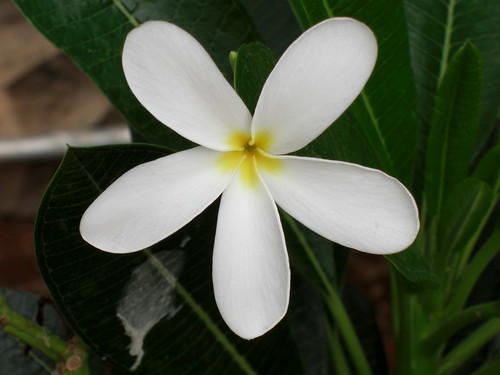
With their heady scents, flowers are often used in perfumery, not only in fragrances but also in potpourri, herb cushions, pomanders and sachets.
Beauty and Hygiene Products
Flowers are frequent additions to beauty products. Elderflowers in an infusion are used to soften skin. An infusion of chamomile can be used as a mouthwash. Food and Drink
Some flowers are edible. Borage flowers (and leaves), for instance, have a cucumber-like flavor. They can be used in salads or crystallized to decorate cakes. Add the flower to wine for an hour before straining to impart a cucumber flavor.
Medicine
Many flowers have traditionally been used in tonics, teas and infusions. An infusion of marigold flowers is said to be good for poor circulation, while fresh or dried bergamot flowers can be used in hot milk as a sedative.
Attract or Repelling Wildlife
Flowers not only can attract helpful pollinators like bees, they also can attract, depending on the flower, butterflies and bats, which can control mosquitoes. Dried lavender flowers repel moths.
About Valentine Flowers for Him
 Overview
Traditionally, it is women who receive flowers and men who give them. The thought of giving flowers to a man may not even cross a woman's mind. However, when you're racking your brain trying to figure out what to give your man for Valentine's Day, you may want to try something unique: flowers.
Misconceptions
Many people assume men wouldn't appreciate a gift of flowers. But a survey conducted by Bruskin/Goldring Research asked 500 men if they would like to receive flowers from a woman for Valentine's Day. According to the results, 61 percent of men of all ages said yes, they would. Keep in mind that this survey was conducted for the Society of American Florists; however, Bruskin/Goldring Research is a well-known and respected name in the research and marketing world.
Colors
Choose flower colors carefully. Find out what each color means. For instance, orange is often a good color choice, as it symbolizes passion and excitement. Also, red may be a good choice. It is the classic color that means deep love and desire. You may want to skip colors like pink, which represents grace and elegance, and lavender, which symbolizes enchantment and also grace and elegance. However, these are merely guidelines---you should also base your choice on your significant other's favorite colors.
Flower Choice
Roses are a sure hit for most women, and possibly for some men. However, consider giving roses with "I love you" embossed on each rose to make it more special and unique for men. Many men also prefer monochromatic arrangements with exotic flowers like orchids or birds of paradise. In addition, consider giving a plant instead of cut flowers. Plants can be indoor varieties or something that can be transplanted outside. Bonsai or bamboo plants may be suitable choices for men who enjoying working with their hands since these plants can be pruned and trained to form different shapes.
Containers
Select a container that you think your man will like. Typically, most men prefer simpler and more modern vases such as a solid black rectangular vase with sharp lines. You can also think outside the box. There are many other kinds of containers to place the flowers in, including car-shaped vases and baseball-shaped mugs. While flowers alone would make a good gift for your man, perhaps you can add a second gift in the card. For instance, choose a baseball mug for the flowers and add baseball tickets in the card. Choose a car-shaped vase and add hotel reservations in the card to symbolize a road trip.
Presentation
Sometimes it's not the gift, but the presentation, that counts. If you are giving him a plant and the idea is to eventually plant it outdoors, it may be best to first present it like you would cut flowers (instead of planting it outdoors ahead of time). However, if you're the green thumb in your household, you may want to include as part of the gift a card or homemade gift certificate that promises to help your mate plant and care for his gift. Also, consider presenting the flowers or plant in a romantic way. Just handing him some flowers in your jogging clothes may not do the trick; instead, make the flowers the centerpiece of a romantic dinner. Or use some of the petals to lay out a path to the flowers and the "real" gift (your choice).
How to Identify Flowers 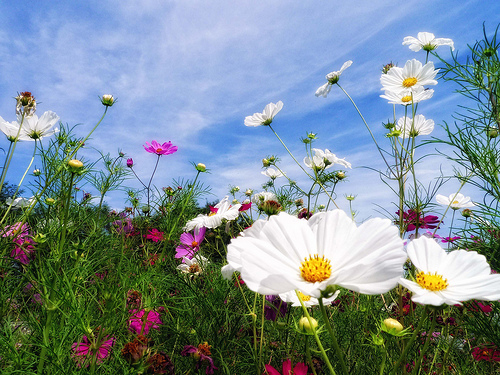
Overview
Flowers come in all sorts of colors, shapes and sizes. Identifying some flowers can be easy, such as thorny roses, while other flowers can bear close similarities to other species. Fortunately, if the flower is difficult enough to identify, flower enthusiasts can simply look at the plant on which the flower is found.
Step 1
Look for thorns on the flower's stem. Thorns are indicators of roses.
Step 2
Count the number of petals. Flowers with several petals that surround and wrap around each other are likely roses. However, some flowers have only one large petal, like lilies.
Step 3
Look at the color of the flower petals. Some flowers can come in a variety of colors, while other flowers come in only one color.
Step 4 Study the pattern on the flower petal. Orchids have petals that are lighter close to the center and become darker at the outer edge. Irises have yellow patches near the center of the flower with purple strips that extend toward the outer edge. Daffodils are yellow with white edges. Violets have yellow centers, violet outer edges and white between the yellow and the violet.
Step 5
See if the flower head rests on the plant. Some flower heads, like roses and tulips, sit on the top of the stem, while other flower heads, like orchids, are attached to thinner stems that branch away from the main stem. If the flower springs out of the ground, it might be a bulb.
Step 6
Look at the shape of the petals. While many petals are round, some petals have long, triangular shapes, like irises and ginger.
Step 7
Consider the size of the flower. Some flowers, like sunflowers, can be very large. Other flowers, like jasmine and flax, are small.
Step 8
Discover the texture of the flower. While a lot of flowers have a delicate texture, ginger flowers are waxy.
Step 9
Look at the stigma. Some stigmas are flat, like sunflowers. Other stigmas protrude, like lime flowers.
Step 10
See if the petals are straight or curly. Some flowers, like lime flowers, can be very curly. Step 11
Study the plant. Does the plant have individual flowers by themselves, or are several small flowers attached to the stem, like with a lavender flower? If you see an enormous number of flowers facing in directions as if they were trying to cover something, you might have a hydrangea. If you see fewer flowers that are purple, you might have lilacs.
Step 12
Look for a cluster of petals shaped like a cup that is surrounded by more petals. This flower is probably a narcissus.
Step 13
Count the number of pistils on the flower. Lotuses have several pistils with bright colors.
Step 14
Analyze the center of the flower. Is the center of the flower large and flat like an aster or a sunflower?
Step 15
See how many rows of petals you find. Flowers with several rows of straight, rolled-up or flaring flowers could be dahlias.
Step 16
Look for long strips of petals with a yellow color throughout. This is the hardy and widely propagating dandelion. If the flower has long, white s trips with a yellow center,this flower is a daisy.
How Does Bleach Help Flowers?
 Why Use Bleach in Flowers?
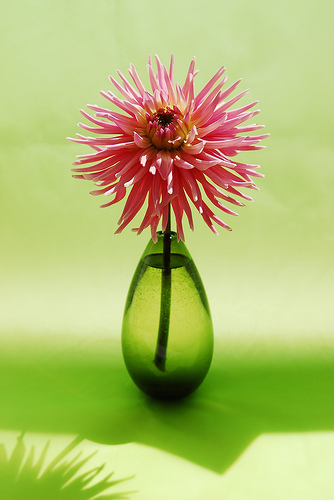
Bleach is a powerful cleaning solution because it disinfects surfaces and kills germs. In the same way, it is also an effective substance to place in the water of cut flowers. Bleach prevents bacteria from growing inside the vase. This bacteria will wilt flowers prematurely and cause the water inside the vase to become moldy. Bleach works similar to the small packets that often come along with flowers at the florist.
Preparing a Bleach Solution
Bleach should be added to the water inside a vase every few days to keep the flowers fresh and free from bacteria. Do not estimate how much bleach you are adding to your water, or you may accidentally add too much and cause the flowers to wilt prematurely. Place 1/4 tsp. of bleach into a quart of water and mix thoroughly. Pour enough solution to completely cover the cut stems of the flowers and discard the rest. Every four days, apply another 1/4 tsp. of bleach to a quart of water and stir, or pour out the water and make a new solution, then pour it back into the vase. Using bleach to preserve flowers is more effective than preserving packets available at the florist.
Warnings About Bleach
Bleach must be treated with care, especially if it is being used in the home. Although breathing in bacteria that grows in a flower vase is dangerous, breathing an undiluted quantity of bleach in an unventilated area can also be dangerous. Use only a small amount of bleach to preserve flowers, and if the smell of bleach is still present in the home, open a window near the vase until the smell dissipates. Take extreme care when pouring bleach, and avoid getting it in the eyes or on the skin. If bleach gets into the eyes or mouth, flush the area with water and call Poison Control immediately. 

Post Your Ad Here
Comments