Top Scan to BIM Companies in 2026
Market Landscape and Growth Projections
The global market for BIM services is experiencing significant growth, driven by the increasing demand for digital transformation in the AEC industry. The market was valued at USD 6.5 billion in 2022 and is projected to reach USD 11.5 billion by 2030, growing at a compound annual growth rate (CAGR) of 7.5% from 2024 to 2030. Similarly, the scan-to-BIM services market is expected to reach US$673 million by 2031, with a CAGR of 5.3%. This growth is fueled by the need for accurate as-built models for renovations, facility management, and the increasing adoption of BIM mandates by governments worldwide.
Key Players in the Scan-to-BIM Market
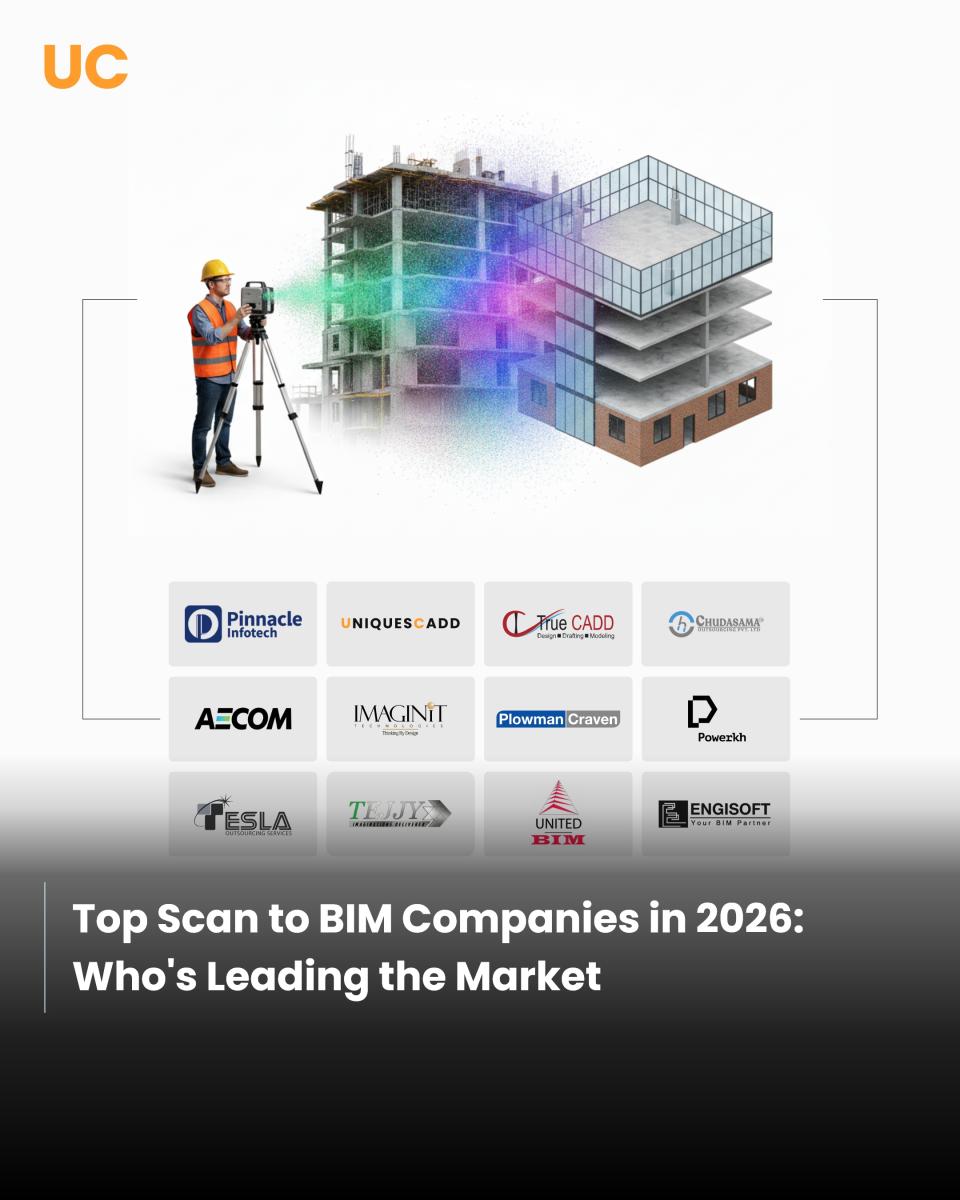
The scan-to-BIM market is segmented into large software and hardware providers, specialized service firms, and emerging technology-focused companies. Below is a list of the top companies leading the market in 2026.
- Pinnacle Infotech Solutions: A specialized BIM and scan-to-BIM service provider known for high-volume, cost-effective services globally.
- UniquesCADD: A well-regarded BIM services provider offering a range of services, including MEP BIM and CAD outsourcing.
- TrueCADD: Highly experienced in processing and managing high volumes of scanned data for complex projects.
- AECOM Infrastructure: A global leader in infrastructure design and engineering, heavily using BIM and scan-to-BIM workflows for large-scale projects.
- IMAGINiT Technologies: A BIM technology consulting firm offering high-end scan-to-BIM services, often coupled with expertise in Autodesk software.
- Plowman Craven: A UK-based company specializing in precise surveying, laser scanning, and scan-to-BIM for commercial and heritage projects.
- Tesla Outsourcing Services: Known for converting point cloud data into highly accurate BIM models for renovation and facility management.
- Tejjy Inc.: Offers comprehensive scan-to-BIM services, including BIM coordination and clash detection.
- United-BIM: A focused provider of scan-to-BIM and related VDC services, emphasizing digital transformation in construction workflows.
- Powerkh: Provides advanced scan-to-BIM and VDC services with a strong emphasis on digital twin creation and model coordination.
Key Trends and Technological Advancements
Several technological trends are shaping the future of scan-to-BIM in 2026, with a focus on automation, integration, and enhanced data utilization.
- AI and Machine Learning: AI is transforming scan-to-BIM workflows by automating object classification, clash detection, and model generation. Machine learning algorithms improve data extraction accuracy and reduce manual effort. The integration of AI is expected to accelerate, making scan-to-BIM more efficient and less reliant on manual intervention.
- Scan-to-Mesh Revolution: The integration of PointFuse's meshing technology into Autodesk's ReCap Pro 2026 is a game-changer. This feature converts raw point cloud data into intelligent, segmented meshes, reducing file size by up to 97% and making them directly usable in Revit and other design tools. This local, native workflow within the Autodesk ecosystem is expected to become a standard in the industry.
- Digital Twins: Scan-to-BIM is a foundational technology for creating digital twins, which are used for real-time updates, predictive analytics, and optimizing building operations over their lifecycle.
- Cloud-Based Collaboration: Cloud-based platforms have become essential for scan-to-BIM, enabling real-time collaboration, secure data storage, and seamless access for distributed teams, improving coordination and reducing errors.
- Mobile and Real-Time Scanning: Mobile laser scanning (MLS) and real-time scanning technologies are increasing data capture speed and efficiency, eliminating the need for GPS and allowing for faster mapping of landscapes and infrastructure.
Challenges and Future Outlook
Despite the advancements, the path to full automation in scan-to-BIM remains challenging. Key obstacles include the complexity of modeling irregular and non-standard building elements, the scarcity of large, diverse, and labeled training datasets for AI models, and the need for high-quality hardware to capture sufficient detail for automation. The industry is moving towards a hybrid approach that combines AI for segmentation with generative modeling for flexible, parametric reconstruction of complex geometries.
The future of scan-to-BIM will likely see significant advancements in high-precision LiDAR systems, the integration of 4D and 5D BIM for enhanced project planning, and a continued focus on sustainability-driven workflows. Firms that effectively leverage these technologies will gain a competitive edge by reducing project risks and improving operational efficiency.
Read More: Scan to BIM Companies in 2026


Comments