Transverse Aeolian Ridges: Blue Ripples on a Red Planet
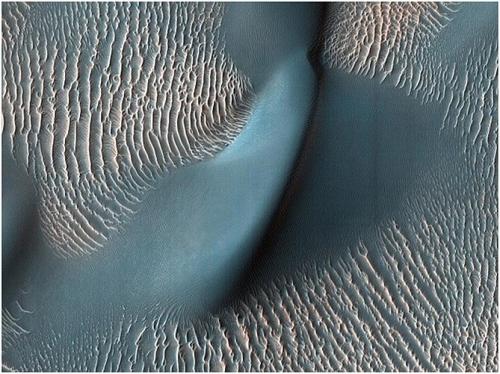
Mars, often referred to as the "Red Planet," has captivated scientists and space enthusiasts for centuries. Its barren and desolate landscape has been the subject of extensive study, revealing a wealth of intriguing geological features. Among these features, one that stands out are the Transverse Aeolian Ridges (TARs), which have been dubbed the "blue ripples" on Mars. Let us delve into the fascinating world of TARs and uncover the mysteries they hold.
Unveiling the Enigma of TARs
Transverse Aeolian Ridges are elongated, sinuous landforms found on the Martian surface. They appear as wave-like ridges that crisscross the landscape, resembling ripples frozen in time. These unique features have puzzled scientists for years, with their formation and composition being the subject of extensive research and debate.
Origins: Winds Sculpting the Martian Surface
The formation of TARs can be attributed to the action of Martian winds. The planet's thin atmosphere, combined with its low gravity, creates an environment where winds can shape the surface features over long periods. As the wind blows across the Martian surface, it interacts with different geological formations, resulting in the accumulation of sand and dust particles to form the characteristic ridges.
Complex Formation Mechanisms
While the influence of winds is a primary driver in the formation of TARs, the exact processes involved are complex and multifaceted. One prevailing hypothesis suggests that TARs form through a combination of wind erosion and deposition. As wind encounters obstacles like rocks or craters, it can create eddies and turbulence that cause sand and dust to settle in the lee side of these obstacles, giving rise to the ridge-like formations we observe.
Unraveling the Blue Mystery
The distinctive bluish appearance of TARs has sparked curiosity and intrigue. The blue hue is a result of how light interacts with the Martian surface materials. It is believed that the fine-grained dust, possibly composed of minerals rich in iron, scatters light in a way that imparts a bluish tint to the ridges. This unique coloration adds to the visual allure of TARs and makes them stand out amidst the predominantly reddish Martian landscape.
A Window into Martian Climate
Studying TARs offers valuable insights into the climate dynamics of Mars. By analyzing the morphology, distribution, and orientation of these features, scientists can infer details about wind patterns, atmospheric conditions, and the history of climate on the planet. TARs act as markers of past and present wind regimes, allowing researchers to reconstruct the environmental conditions that have shaped the Martian surface over time.
Similarities with Earth's Landforms
While Mars and Earth have distinct geological characteristics, TARs bear some resemblance to certain landforms found on our own planet. On Earth, similar features known as transverse dunes can be observed in desert regions. These dunes share some similarities with TARs, showcasing the universal nature of wind-driven processes in shaping planetary surfaces.
Robotic Explorers Unveiling Martian Mysteries
Robotic missions, such as the Mars rovers and orbiters, have provided valuable data and imagery of TARs, aiding scientists in their quest to unravel the secrets of these enigmatic Martian features. High-resolution images and detailed measurements have enabled researchers to study TARs up close, providing valuable data for further analysis and interpretation.
Continued Exploration and Discovery
As our understanding of TARs continues to evolve, future missions to Mars, such as the Mars Sample Return mission, hold great promise for shedding more light on these intriguing features. By collecting and returning samples from the Martian surface, scientists will gain direct access to the materials that make up TARs, allowing for detailed laboratory analysis and a deeper understanding of their composition and formation.
Unlocking the Secrets of Mars
The study of Transverse Aeolian Ridges on Mars represents a fascinating avenue of research that contributes to our broader understanding of the Red Planet. These blue ripples serve as reminders of the complex geological processes at play and provide glimpses into Mars' past and present climate. Through the combined efforts of robotic explorers, remote sensing, and laboratory analysis, we inch closer to unraveling the secrets that lie within the enigmatic TARs, uncovering more about the geological history and evolution of Mars.
Post Your Ad Here
Comments