Transform Any Surface into a Touchscreen with this Device and Other Science Tech
Happy Monday! It’s another week and we’re back with more
science and technology news to wake your inner geek.
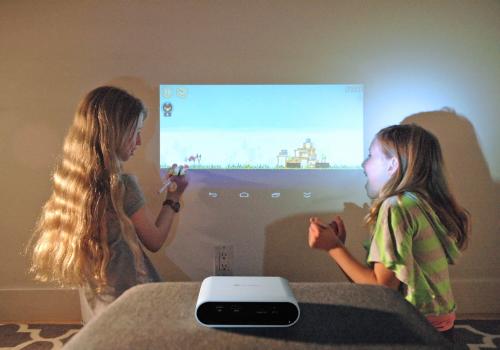
Transform Any Surface
into a Touchscreen with this Device
Are you one of those people who hate the fact that there are
so many touchscreens in the world? Well, TouchJet’s Pond might be the ideal
solution - allowing any surface to be converted into an 80-inch interactive touchscreen.
The device, costing $599, debuted on Indiegogo and secured a funding of over $900,000.
Helen Thomas, CEO of TouchJet, explains why it is becoming
increasingly difficult for people to share experiences because of different
screens.
“More and more people, especially young children, are using
touch technology because of smartphones, but as much as smart devices are
connecting people around the world, people are isolated because everybody is
sucked into a small screen. So that’s really the mission of the company, to
create a shared experience. Now, when a family goes on vacation, they can watch
a movie together wherever they are—if they are at a beach house, in the wild,
or in a camp.”
Monitoring Vital Signs
using Ingestible Sensors
Vital signs can be measured using tests like ECG and pulse
oximetry, or using wearable monitors. Both the methods require contact with the
patient’s skin and some degree of pain. However, researchers at MIT’s Koch
Institute for Integrative Cancer Research have developed an ingestible sensors
that can measure heart rate, respiratory rate and temperature from the
digestive tract.
"What we did with our technology is identify components
that were compatible with ingestion. These are very small microphones similar
to the ones that are used in common cellphones and actually listen from within
the body and can extract the heart rate and respiratory rate," says Giovanni
Traverso, Researcher at MIT's Koch Institute for Integrative Cancer Research.
The device hoists a small microphone in a silicone capsule
that listens for heart and lung sounds, and decodes this information using
advanced signal processing systems.
Lab-on-a-Chip
Digitization Paves Way for More Accurate Medical Testing
Researchers at the School of Electrical and Computer
Engineering at Georgia Institute of Technology have come up with a way to assign
digital codes to information obtained through microfluidic chips, allowing for
much more accurate medical testing outside of hospitals and clinics.
“We have created an electronic sensor without any active
components. It’s just a layer of metal, cleverly patterned. The cells and the
metallic layer work together to generate digital signals in the same way that
cellular telephone networks keep track of each caller’s identity. We are
creating the equivalent of a cellphone network on a microfluidic chip,” says Fatih
Sarioglu, Assistant Professor at the School of Electrical and Computer
Engineering at Georgia Institute of Technology.
Microfluidic chips are referred to as ‘lab-on-a-chip’
technology, and can test small amounts of samples and make detections and
separations with a high degree of accuracy.
Read more at www.bit.ly/q3newsblog.
Q3 Technologies partners with global
companies to develop complex software applications across different industry
domains. We are focused on offshore
software development in Gurgaon including technology consulting,
application migration and modernization, end-to-end support & maintenance
and IT/Infrastructure support services.
Post Your Ad Here
Comments