Texas Energy Exploration LLC: Salt-Dome Locations
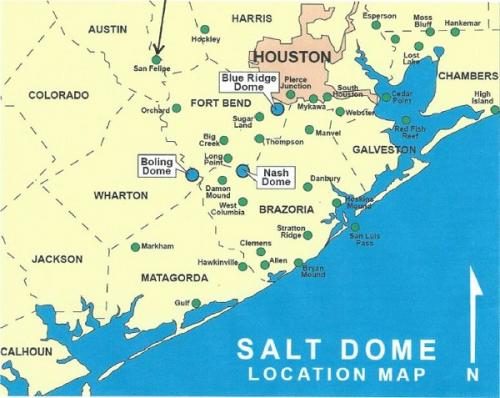
Salt- Dome
Locations in the Gulf Coastal Plain, South-Central United States
ABSTRACT
Information on salt domes in the Gulf of
Mexico Coastal Plain, south-central United States and the adjacent Continental
Shelf were compiled from major published sources, 1973-84. The location of 624
salt domes is shown on a map at a scale of 1:1,500,000. A color coding system
was used to show that the occurrence, size, shape, and location of these domes
varies among sources. Two tables of additional data accompany the map and
include other available information such as: identifying sources, depth to salt
and caprock, diameter, volume, name, and uppermost zone of surrounding sediment
that is penetrated, as well as the number of matches between sources. * The
locations of salt domes that penetrate specific permeable zones within the gulf
coast regional aquifer systems are shown on maps.
INTRODUCTION
The Gulf Coast Regional Aquifer-System
Analysis (RASA) covers an area of 230,000 square miles onshore and 60,000
square miles of the adjacent Continental Shelf (fig. 1) (Grubb, 1987). The
aquifer system consists of Cenozoic sediments that were divided into aquifers,
permeable zones, and confining units (Grubb, 1987, p. 104). This division was
accomplished by: 1) Identifying a really extensive units of low permeability;
2) identifying large hydraulic conductivity contrasts between adjacent
permeable zones not separated by a regional confining unit; and 3) identifying
variations in hydraulic head with depth (Weiss and Williamson, 1985; Weiss, 1990;
and Hosman and Weiss, 1988).
PURPOSE AND
SCOPE
This study was initiated under the Gulf Coast
Regional Aquifer-System Analysis to compile published data on salt domes to the
edge of the Continental Shelf. The composite data were compiled to study the
possibility of salt domes as a source of salt in brine waters in Cenozoic sediments
of the Gulf of Mexico Coastal Plain in the south-central United States and
adjacent Continental Shelf (Williamson and others, 1990, p. 107). The
shallowest permeable zone penetrated by each dome has been identified in order
to assess the possibility of salt dissolution and movement through the
permeable zones. In this report, the compiled data are displayed on a map and
in a table. Salt-dome locations and geometry were compiled from eight sources,
each of which investigated all or part of the study area. Salt-dome name,
location, depth to salt and caprock, diameter, volume, and identifying sources
used for this compilation are provided in a table.
DISCREPANCIES
BETWEEN REFERENCES
Identification of salt dome locations from
each of the references used to construct plate 1 are compared in table 1. The
discrepancies in dome identification between references are due to several
factors. First, the more recent references reflect advances made in seismic
surveying and other remote sensing methods of geophysics. Therefore, some
structures that were identified by earlier references as salt domes have been
reclassified as non-salt structures, whereas other salt domes have been
identified for the first time. For this reason, recent references were favored
in compiling these data. Second, despite the advancements, identification of
salt domes from seismic surveys remains highly subjective (such that two people
using the same data may reach different conclusions). Third, the different
investigations are based on different databases of raw material and published
information. For example, the U.S. Department of the Interior (1983) lists
neither Martin (1980) nor Halbouty (1979) as references. Halbouty (1979) lists
only those salt domes that have been confirmed by drilling, so that his base
list of 343 domes should be considered fundamental. However, Halbouty (1979)
also identifies some domes that no other sources identified (for example,
Eugene Island Block 231). Finally, the references use different depth criteria for
identifying salt domes from deeper salt structures.
Understanding the problem of locating and
identifying salt domes from seismic survey data is important because seismic
surveys are a major source of information for most of the references used in
this report. For example, most of the offshore domes from Martin (1980) were
identified from single-channel seismic surveys and gravity surveys.
Single-channel seismic analysis does not allow for the differentiation between
salt domes and shale plugs (Martin, 1980) because both are piercement
structures of similar densities. This may explain the large number of
structures (481) that Martin (1980) identified. Additionally, the actual
location of salt domes may be blurred because of an effect called sideswipe that
allows structures some distance from the map trace of the seismic line to be
projected onto the line. Exact salt dome locations can be determined only from
a very tight pattern of seismic lines and by correlating seismic surveys with
other data.
Post Your Ad Here
Comments