Superhuman Hearing for Soldiers and Other Future Tech
Its #FunFriday! And we’re back with the latest science and
technology news for the week. Enjoy today’s digest!
Superhuman Hearing
for Soldiers
We’ve seen numerous examples of futuristic technology being
developed for the defense industry. And truly, war can be a traumatizing
experience for everyone affected by the conflict on both sides. Soldiers, for
example, often suffer from loss of hearing because, well, gunshots are loud,
and general foam-based earplugs hinder a soldier’s ability to listen to a
commander’s orders.
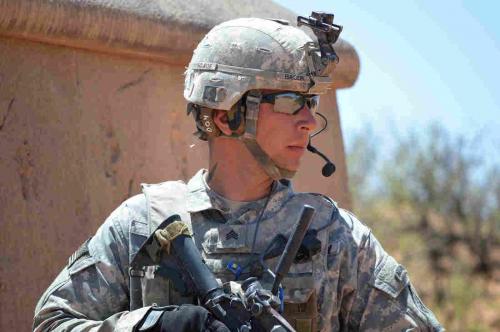
The Department of Defense has announced plans to integrate a
new piece of technology, called Tactical Communication and Protective System
(or TCAPS), to help solders tune out unwanted audio in a battlezone.
“Soldiers have told me quite openly, the main reason they
refused to wear, or partially wear, hearing protection while out on a mission
was because it hindered their overall situational awareness. The Army's focus
with the TCAPS is to minimize training and battlefield related hearing loss,
while improving overall situational awareness, increased mission effectiveness,
safety and survivability,” said Capt. Jennifer Noetzel, Audiology Chief of the
Army’s NY hearing program at Fort Drum.
The Four New Elements
of the Periodic Table
We can now finally complete the 7th row of the
periodic table. Elements 113, 115, 117 and 118 will now be known as nihonium,
moscovium, tennessine and oganesson respectively, pending a public review.
According to NewScientist, “Moscovium (Mc) and tennessine
(Ts), formally elements 115 and 117, were proposed by teams at the Joint
Institute for Nuclear Research in Dubna, Russia, and Oak Ridge National
Laboratory, Vanderbilt University and Lawrence Livermore National Laboratory
(LLNL) in the US, after Moscow and Tennessee. Oganesson (Og) was proposed by
the Dubna and LLNL teams after Yuri Oganessian, a Russian physicist who helped
discover element 114 in 1999.”
Repairing Liver
Damage using Modified Virus
Liver damage occurs when healthy liver cells, called hepatocytes,
are damaged and filled up by myofibroblasts that generate scar tissue in the
walls of the liver. The liver fails as it is not able to generate enough
hepatocytes to repair the scar tissue. To combat and even reverse liver damage,
researchers from the University of California in San Francisco have devised a
new way to repair liver damage using a modified virus to change bad cells into
good ones.
“Part of why this works is that the liver is a naturally
regenerative organ, so it can deal with new cells very well. What we see is that
the converted cells are not only functionally integrated in the liver tissue,
but also divide and expand, leading to patches of new liver tissue," said Dr.
Holger Willenbring, a Professor of Surgery at the University of California.
Post Your Ad Here
Comments