Must See Havelis of Jaisalmer Rajasthan
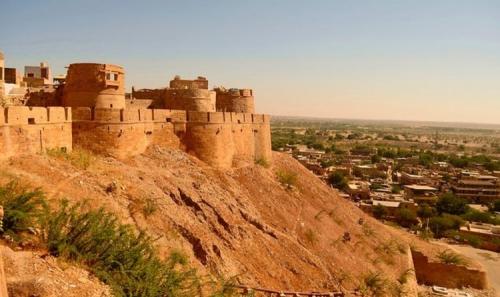

Jaisalmer in Rajasthan offers unique experiences, in terms of History, Art, Culture and Cuisine . The golden city of Jaisalmer is extremely popular with the travellers - both international and domestic. If you are planning a holiday to Jaisalmer , the Havelis of Jaisalmer are not to be missed , These havelis offer you a glimpse into the art , history and the architecture of the desert city.
Some of the most enchanting Havelis that the tourists must visit are listed below:
Patwon ki Haveli
Not to be missed in the city are some of Rajasthan's most famous havelis. The 'Patwon ki Haveli' is a group of five havelis built by a wealthy Bafna Oswal, Guman Chand, a trader in gold and silver and a moneylender. These havelis were built for his five sons between A.D. 1800-1860. The opulence of carving on the stone façades is a testimony to the immense wealth of this family. Every inch of the façade of these six-storeyed havelis is carved in fine detail and was obviously executed by the best gazdars or artisans specialized in fitting together carved stones, and shilpin or master stone carvers of that time.
The entrance to the Patua Street is marked by a tall gate that is four storeys high. All the five havelis are built on a high plinth and each has a similar plan with interesting niches and airy rooms. Hidden safes and vaults provide further evidence of wealth. 'Surangdar' pillars and 'bangalidar' arches support the structures.
There is a somewhat illogical swathe of land opposite these havelis whereby hangs a piquant tale. It is said that a haveli was actually pulled down to create this open area so that a visiting dignitary could view the havelis better! Surely, this is a rather bizarre testimony to their beauty. On this open plot, the son of famous dacoit
Karna Bheela, who featured in the Guinness Book of Records as the man with the longest moustache in the world, sits with his ektara. The son is obviously trying hard to beat his father's record.
Down the road is a contemporary haveli built by a businessman from Ahmedabad, which is also a very good example of the skills of the modern craftsmen.
Salim Singh ki Haveli
Salim Singh, the much-feared and hated prime minister of Jaisalmer during the reign of Maharawal Mool Raj Sagar built this haveli in A.D. 1815. An amazing architectural feat, this top-heavy umbrella-like structure, almost completely bereft of ornamentation on the lower levels, has numerous decorative baris (windows) and heavy ornamentation at the higher levels.
The historian Adams has this to say about the haveli: 'The house of the notorious Diwan Salim Singh, who devastated the country nearly a hundred years ago with his extortion and cruelty is magnificently carved and towers above the rest of the city. It is a very grand edifice of six storeys of cut stone with cupolas and much ornamentation especially on the top storey.' Unfortunately this magnificent haveli now lies in a state of disrepair. Two of its top storeys collapsed some time back and the recent earthquake in January 2001 damaged the haveli further. Owned by seven brothers, only one lives in it at present and no one seems to care about its upkeep.
Dewan Nathmal ki Haveli
This is a unique structure as it has along with traditional motifs, steam engines and bicycles carved on its facade. This late 19th century haveli was constructed by the famous Gazdar brothers Hathi and Lalu, one having built the left and the other the right side, both of which seem to blend in perfect harmony at the centre. However, close scrutiny will reveal the differences in design. Large stone elephants flank the haveli. The facade is carved of seven stone slabs with a huge central jharoka, a small window on one side and jalis on the other. This configuration is quite unique. Murals and engravings inside the haveli are of a very fine quality and traditional interlocking of stones lends strength to the structure. Privately owned by the family of the Diwan, it is open to public every day between 10.30 a.m. and 5 p.m.
Mandir Palace
Legend says that the Maharawals moved their residence from the fort down to the city because of a curse that no son would be born to them in the palace. For seven generations they actually did not have a son and so they moved out of the fort during the reign of Maharawal Jawahar Singh. The astounding fact is that as soon as they moved to Mandir Palace a son was born to the Maharawal and the direct line of descent continues till today. The Mandir Palace complex has two palaces and many temples, hence its name. The older of the two main palaces, Badal Vilas built by Maharawal Berisal and a six-storeyed tower, shaped like a tazia, are intriguing. The other palace, Jawahar Vilas, built by Maharawal Jawahar Singh in 1940 is the most modern palace in jaisalmer. Craftsmen have used beautiful designs and motifs to carve out a gorgeous facade. The state emblem of Jaisalmer too is carved in stone in this palace. A part o this palace has been converted into a hotel which has taken away some of its charm.
Gadisar
This man-made lake was the lifeline of the people of Jaisalmer before piped water came to the city. A touching tale is attached to its name; after Rawal Gharsi, who had started excavating the lake was killed by his own guard on its shores, his widow queen then continued the noble task and named the lake after him.
Gadisar also has a famous gate named after a beautiful courtesan, Teelon, whose charm captivated many a nobleman. She dreamt that a gate should be built at Gadisar but when it was built, people of the town objected and went to the Maharawal Sali-vahan Singh, who ordered that it be brought down. Teelon obviously was as clever as she was beautiful for she had made a temple of Lord Vishnu on top of the gate ensuring that nobody would demolish it. So the gate stays as it was till today, and is known as Teelon ka Prol.
Adjacent to the main lake is a small structure called Moomal ki Meri, named after the legendary heroine of Jaisalmer and said to have been built in her memory by her lover Mahendra. The lake fills up during the rains and all around it different communities have built small stone structures called banishes. It is a favourite picnic place with the locals.
A charming folk museum near the lake, started by a single dedicated schoolteacher, N.K. Sharma, attracts many visitors.
For more information on Jaisalmer Tour Packages or Rajasthan Tour Packages contact Swan Tours - One of the leading travel agents in India promoting tourism in the state of Rajasthan.Post Your Ad Here
Comments