Mehrangarh Fort -Testimony to Bravery and Valour
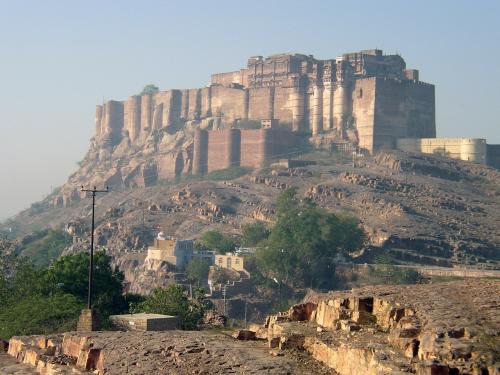
Mehrangarh Fort
-Testimony to Bravery and Valour
Today in the Virasat
Sheeshmahal's Royal atlas we are bringing you the all about the best
destination in Jodhpur, the royal saga of history is related with it, with the
latest trends it is one of the most visited place for pre-wedding photography
in Jodhpur, explore the Mehrangarh fort with this post.
Mehrangarh fort
One can assume the grandness of the
Mehrangarh fort from the fact that it is situated at a height of 112 metres
from the ground level. It is surrounded by infrangible barricades around all
the sides and world famous for its intricate carvings and engravings and larger
than life premises. There are a number of small palaces and temples inside the
fort. A warped canyon and a connected road way strings it to the city of
Jodhpur. One has to cross Seven gates have to reach the fort. These gates still
bear the marks of the various battles fought in the bygone era and stand
witness to canon ball hits by attacking armies of Jaipur during wars.
There are seven gates, which include
Jayapol (meaning 'victory'), built by Maharaja Man Singh to commemorate his
victories over Jaipur and Bikaner armies. Fattehpol (also meaning 'victory')
gate was built by Maharaja Ajit Singh to mark the defeat of the Mughals. The
palm and war attack imprints upon these are still visible and make an
attraction for rajasthan tourism and candid photography grabs
much attention towards the Rao Rajputs.Rao is BrahmbhattJagirdar clan of Rao
Jodha. Rao is Rajputs and in Gujarat they call ‘barot’ and Rao Saheb.
The museum in the Mehrangarh fort is
one of the most well-stocked museums in Rajasthan. The museum is the home to
some of the most finest and memorable preserves and relics of India country
life. In one section of the fort museum there is a selection of old royal
palanquins, including the elaborate domed gilt Mahadol palanquin which was won
in a battle from the Governor of Gujarat in 1730. The museum exhibits the
heritage of the Rathores in arms, costumes, paintings and decorated period
rooms.
Mehrangarh also became one of the
hottest destinations international destinations once it became the shooting
place for the famous film ‘Dark Knight’. The shots when Bruce Wans is
captivated and attacked in Jail were shot here.
History of Mehrangarh
Rao Jodha, the chief of the Rathore
clan, is credited with the origin of Jodhpur in India. He founded Jodhpur in
1459 (Jodhpur was previously known as Marwar). He was one of Ranmal's 24 sons
and became the fifteenth Rathore ruler. One year after his accession
to the throne, Jodha decided to move his capital to the safer location of
Jodhpur, as the one thousand years old Mandore fort was no longer
considered to provide sufficient security.
With the trusted aid of Rao Nara (son
of Rao Samra), the Mewar forces were subdued at Mandore. With that, Rao Jodha
gave Rao Nara the title of Diwan. With the help of Rao Nara, the foundation of
the fort was laid on 1 May 1459 by
Jodhaon a rocky hill 9 kilometres to the south of Mandore. This hill was known
as Bhaurcheeria, the mountain of birds. According to legend to build the fort
he had to displace the hill’s sole human occupant, a hermit called
CheeriaNathji, the lord of birds. Upset at being forced to move CheeriaNathji
cursed Rao Jodha with, “Jodha! May your citadel ever suffer a scarcity of
water!” Rao Jodha managed to appease the hermit by building a house and a
temple in the fort near the cave, the hermit had used for meditation, though
only to the extent that even today the area is plagued by a drought every 3 to
4 years. Jodha then took an extreme measure to ensure that the new site proved
propitious. He buried a man called ‘Raja Ram Meghwal’ alive in the foundations.
Raja Ram Meghwal was promised that in return his family would be looked after
by the Rathores. To this day his descendants still live in Raj Bagh, ‘Raja Ram
Meghwal's’ Garden, an estate bequeathed them by Jodha.
Also Read: - 12 Most Delicious Dishes from TheRajasthani Platter
An
inventory of valuable preserves
Within the fort are several
brilliantly crafted and decorated palaces. These include, MotiMahal (Pearl
Palace), PhoolMahal (Flower Palace), SheeshaMahal(Mirror Palace), SilehKhana and
DaulatKhana. The museum houses a collection of palanquins, howdas, royal cradles,
miniatures, music instruments, costumes and furniture. The ramparts of the fort
house preserved old cannon, including the famous Kilkika and provide
breath-taking view of the city.
Also Read: - A Window to History-Abhaneri
Elephant’s
howdahs
The howdahs were a kind of
two-compartment wooden seat (mostly covered with gold and silver embossed
sheets), which were fastened onto the elephant's back. The front compartment, with
more leg space and a raised protective metal sheet, was meant for kings or
royalty, and the rear smaller one for a reliable bodyguard disguised as
a fly-whisk attendant.
Palanquins
Palanquins were a popular means
of travel and circumambulation for the ladies of the nobility up to the second
quarter of the 20th century. They were also used by male nobility and royals on
special occasions.
DaulatKhana - Treasures
of Mehrangarh Museum
This gallery displays one of the most
important and best preserved collections of fine and applied arts of the Mughal
period of Indian history, during which the Rathore rulers of Jodhpur maintained
close links with the Mughal emperors. It also has the remains of Emperor Akbar.
Armoury
This gallery displays a rare
collection of armour from every period in Jodhpur. On display are sword hilts
in jade, silver, rhino horn, ivory, shields studded with rubies, emeralds and
pearls and guns with gold and silver work on the barrels. The gallery also has
on display the personal swords of many emperors, among them outstanding
historical piece like the Khaanda of Rao Jodha, weighing over 3 kg, the
sword of Akbar the Great and the sword ofTimur.
The Turban
Gallery
The Turban Gallery in the Mehrangarh
Museum seeks to preserve, document and display the many different types of
turbans once prevalent in Rajasthan; every community, region and festival
having had its own head-gear.
National
Geological Monument
The Jodhpur Group - Malani
Igneous Suite Contact on which the Mehrangarh Fort has been built has been
declared a National Geological Monument by the Geological Survey of
India to encourage Geotourism in the country. This unique geological
feature is part of the MalaniIgenus Suite seen in the Thar desert region,
spread over an area of 43,500 km2.
This unique geological feature represents the last phase of igneous activity of
Precambrian age in the Indian Subcontinent.
Post Your Ad Here
Comments