LiFi is 100 times faster than WiFi
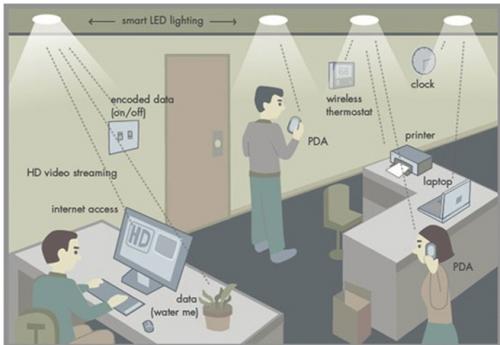
In 1880, Alexander Graham Bell, the inventor of the
telephone, transmitted audio using visible light. Now, a new type of data transmission
is here. We hear a lot about using WiFi on our phones and computers, however,
LiFi could be much faster. This new type of technology, known as LiFi, has
allowed scientists to achieve speeds of 224 GB per second in a lab. This
implies that users can download almost 18 movies, 1.5GB each, per second.
Invented by Harald Haas, professor at Edinburgh University,
LiFi uses LEDs (Light Emitting Diodes) to transmit data at speeds unparalleled
to WiFi technology. He invented this wireless broadband technology in 2011, and
is co-founder of a company known as PureLiFi, formerly called pureVLC, that
sets up commercial Li-Fi products for integration with existing LED systems.
LiFi, or Light Fidelity, is more energy efficient and is
capable of upto 10,000 times the bandwidth of WiFi. Whereas WiFi uses the unlicensed
2.4GHz or 5GHz radio spectrum, LiFi uses visible light communication (VLC)
between 400 and 800 terahertz (THz).
VLC works by flickering an LED on and off at incredible
speeds, oblivious to the naked eye, to transmit information in binary code,
similar to Morse code. A LiFi system consists of an LED transmitter and a solar
panel receiver system. It employs use of specialized LED driver chips. Turning
off the LiFi lights does not mean that the network would be switched off. LiFi
LEDs can be dimmed to such low levels that they appear turned off.
By 2019, it is estimated that the world would exchange more
than 35 quintillion bytes of data each month. A disadvantage in WiFi is that
overcrowding makes the technology slower and congestion causes network
problems. This is the main reason why 5GHz WiFi routers are faster, because it
is a new type of band and most routers are configured for 2.4 GHz, thus
preventing overcrowding. However, when all routers are 5GHz compatible, the
speeds will be the same. Also, routers are only about 5% efficient as most of
the energy is being used to cool the apparatus.
LiFi helps eliminate congestion problems because light
cannot pass through walls, as compared to WiFi. It also makes the network more
secure, because most WiFi signals can be intercepted by users in the vicinity.
"All we need to do is fit a small microchip to every
potential illumination device and this would then combine two basic
functionalities: illumination and wireless data transmission," Haas said.
"In the future we will not only have 14 billion light bulbs, we may have
14 billion Li-Fis deployed worldwide for a cleaner, greener, and even brighter
future."
The LiFi market is expected to grow at a rate of 82% from
2013-2018, and be worth over $6Bn per year by 2018. Although LiFi would not
completely eliminate WiFi from homes and offices, since removing the
infrastructure already present would not be feasible, it could work together
with WiFi. Many companies are implementing this technology in their homes and
offices.
Oledcomm, a French technology company, is in the process of
installing its own LiFi in local hospitals. Velmenni, an Estonian company, has
already developed a commercial version of the technology. Philips has developed
a VLC system for shoppers at stores, where a shopper downloads an app and is
shown coupons and information based on which section of the store they are in.
Post Your Ad Here
Comments