Information on Lakes of Srinagar Kashmir
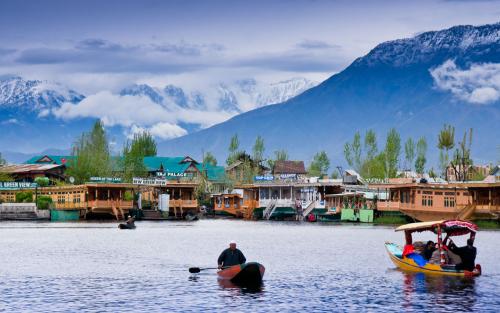

The quintessential image of Srinagar is that of the beautiful Dal Lake, with houseboats moored on its banks and shikaras floating on its tranquil waters. The ethereal beauty of this scene has enthralled visitors across time, from the Mughals and the British to the traveller of today.
Set against the majestic backdrop of the Zabarwan range, the Dal is truly 'Srinagar's jewel'.
It is not surprising than the picturesque setting of the lake, with languidly floating shikaras, has featured in many romantic Bollywood songs. A popular song is 'Ye chand sa roshan chehra' from Kashmir ki Kali, which has Shammi Kapoor wooing the beautiful Sharmila Tagore on a shikara. More recent is Preity Zinta singing ' Socho ki jheelon ka sheher ho / Lehron pe apna ik ghar ho...' while dressed in traditional Kashmiri attire in Mission Kashmir.
A glacial lake, the Dal's shoreline stretches 15.5 kms, lined with beautiful Mughal gardens (see p 18), parks and hotels, and with houseboats anchored along its banks. Like the city, the lake too changes character with the season: in late summers it is abloom with pink lotuses and lilies, in the height of winters it dons a silver sheen, parts of it covered with a thin sheet of ice — both equally spectacular.
Awed by the beauty of the Dal, the Mughals built picturesque gardens both along its banks and overlooking it — Shalimar, Nishat, Chashme Shahi and Pari Mahal being the most splendid. Char Chinar, where four chinar trees (see p 21) stand on an island in the middle of the lake, is a popular landmark. There are several other sites of interest along the lake — Hazratbal shrine on its northwest bank; Nehru Park; the Shankaracharya Hill and temple; and the two golf courses near its south bank.

The Boulevard is the arterial road running along the southern banks of the Dal Lake, lined with hotels, restaurants, shops, banks and Internet cafés. Busy at most times of the day with walkers, vehicular traffic and tourists, it is also a favourite with joggers and cyclists — all taking in its many sights.
Covering an area of 18 sq km, the Dal is part of a larger wetland, and is made up of four basins divided by causeways — of which the smaller Nagin Lake, lying to its northwest, is best known. The Nagin, though often seen as an independent lake, is linked to the mother-lake through a narrow channel. Riding in a shikara on the Nagin, one can see the fort on top of Hari Parbat, playing solemn witness to life below.
Dal has nearly 1,400 tourist houseboats anchored on it, most along the periphery of the lake close to the Boulevard, fewer on the Nagin and even less on the Jhelum. Hand-crafted, the houseboats are generally made from local cedar wood, with intricately-carved interiors. Offering anything from a single room to four (or even six) room accommodation, the boats are graded according to the level of comfort they provide. If you can afford to splurge, deluxe houseboats offer the finest luxury in terms of its interiors - palatial rooms with crystal chandeliers, often with decks and a terrace overlooking the lake - hospitality and gastronomy. All houseboats, regardless of category, have highly personalized service, with the owner and his family never far away.
The houseboats are named romantically and even whimsically: Princess, Flower of the Lake, for instance, or Monalisa, Phoenix, Star of Asia, Istanbul, Venice. In 1966, Pandit Ravi Shankar taught George Harrison to play the sitar on one of these houseboats. At the Boulevard, one is spoilt for choice with countless boats standing cheek by jowl. The boats in the Nagin are far fewer. While Dal has an electrifying energy to it, for those wanting calm and quietude, Nagin is a better bet.
For further information on Kashmir Tour Packages, contact a travel counsellor at Swan Tours - Leading Travel agents in India.
Post Your Ad Here
Comments