Google’s Secretive Project Skybender
We all know about Google’s ‘holy’ plan to transmit internet
from the skies. The search engine giant has a new secretive project in store codenamed
Skybender. Think of a scenario like – self-flying drone aircraft with the sole
purpose of delivering internet to people below.
Google has been testing solar-powered drone aircraft that deliver
wireless 5G internet to replace cellphone towers. It would deliver high-speed
internet from the skies, much like Project Loon that uses unpowered hot-air balloons
to beam internet from high above.
The technology, called Millimeter Wave technology, has been
thought (since a long time) to be the key factor in future wireless data
transmission. This is because current data transmission solely depends on
bandwidth, and as more users log on, the data delivery rate slows down as more
connections are cluttered, causing interference between the wireless waves.
Since millimeter wave technology has a completely new spectrum separate from
4G/LTE/WiFi, it will be less cluttered.
Millimeter wave transceivers are able to send and receive
gigabits of data, almost 40 times faster than current WiFi/4G LTE systems. In
millimeter waves, the distances between the peaks and troughs of the waves
(think of a sine wave’s highs and lows) are shorter, thus more data can be sent
in one instance.
However, much like radio waves can travel long distances
because of the large distance between the peaks and troughs, millimeter waves
will be limited in range due to the shorter distance between the peaks and
troughs. Thus, drones are an ideal choice when it comes to low-range data
transmission.
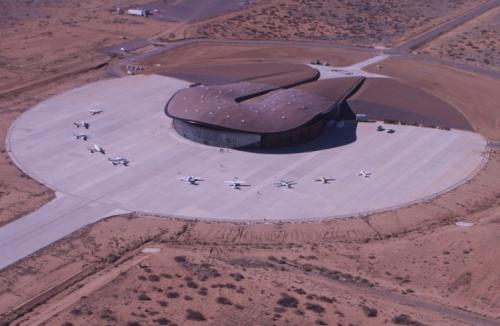
Google has rented a 15,000 sq. ft. hangar for $1000/day in
the Gateway to Space building designed by Richard Foster (of Virgin Galactic)
in Spaceport America. The company built two prototype millimeter wave transceivers
to test with the drones at the facility. Also in their arsenal lies a dedicated
flight control systems centre in the Spaceflight Operations Center that is
separate from the terminal. Apart from the building infrastructure, Google also
has access to Spaceport’s runway for drone takeoffs and landings.
The aircraft being tested is the Centaur (optionally-piloted)
along with 50m wingspan solar-powered drones built by Google’s Project Titan
team. Google acquired New Mexico-based Titan Aerospace in 2014.
Project Skybender is under the Google Access Team, the same
team was also in charge of Project Loon. Although Project Loon garnered much
attention, it
was unable to secure any major deals despite various agreements.
Also read –
Facebook’s Internet Connectivity Drone to Rival Project Loon
Post Your Ad Here
Comments