Google’s Quantum Computer is 100 Million Times Faster than Intel Chips
Quantum mechanics is a topic most engineering students hate
to study. The idea is that everything we have learnt about physics and
chemistry changes completely when we come down to the atomic and molecular
level.
For years, scientists have been trying to develop a computer
that runs on the principles of quantum mechanics, but without much success.
However, today, all this changes. In partnership with NASA, Google has developed
its own quantum computer that can run 100 million times faster than the
computers of today.
The first-ever idea of a quantum computer was proposed by
British physicist David Deutsch in 1985. A classical computer (computers of
today) holds information, called ‘bits’, in small transistors. The bits can be
either ‘0’ or ‘1’ (binary logic), with ‘0’ implying that the state is ‘off’,
and ‘1’ implying that the state is ‘on’. All computers which exist today operate
using binary logic.
In a quantum computer, the machine stores information in a ‘qubit’
(quantum bit). It can store both ‘0’ and ‘1’ simultaneously. Two qubits can
hold 00, 01, 10 and 11. Since a qubit can hold multiple values at the same
time, theoretically, this increases the computing power exponentially.
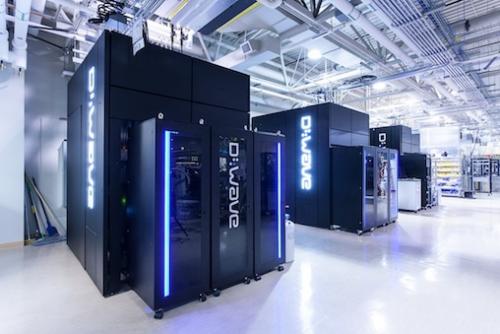
A Canadian computer research company called D-Wave started
building the first quantum computer in 2010 based on research work done at MIT.
In 2013, Google and NASA purchased one of these machines.
The D-Wave 2X (a newer model) has over 1,000 superconducting
circuits that enable flowing current. The qubits are tiny particles held in magnetized
states at temperatures of near absolute zero. At this temperature, the circuits
enter into a quantum state where current flows both clockwise and
anti-clockwise at the same time. The machine then operates on these qubits and
determines the probability of specific circuits to exhibit a particular state
when temperature is raised.
When researchers ran tests of various algorithms on standard
computers and tried to execute the same tests on quantum machines, a difference
of 100 Million in computing power was realized.
“That’s an impressive figure, but we're not quite in the age
of quantum computing just yet. While these results are intriguing and very
encouraging, there is more work ahead to turn quantum enhanced optimization
into a practical technology,” said Hartmut Neven of Google.
D-Wave has sold its machines to the likes of Lockheed Martin
and the Los Alamos National Laboratory. Microsoft believes the first working
quantum computer will be available by 2025. It is clear that although not fully
adaptable in modern computing, the D-Wave 2X is a necessary first step to
revolutionize computing forever.
Post Your Ad Here
Comments