Fun and Little Known Facts about the UK’s Capital City, London
It is hard to find someone who doesn’t love London and it is also hard to find someone who doesn’t have a fact or two about the UK’s capital.
Here are some fun and lesser known facts about London that you hopefully haven’t heard before.
The Queen needs permission from the Lord Mayor to enter the City of London. The Royal website states: “The citizens of London, through the Corporation of the City, still retain their ancient privilege of being able to bar the Sovereign from entering their streets”.
Now only the capital of the UK, London was once the capital city of 6 countries at the same time. In the middle of WWII, London was one of the few ‘safe’ cities in Europe for those who opposed the Nazi regime. It soon became a safe haven for the governments of the countries Hitler invaded. First the government of Poland moved to London followed by Norway, Belgium, Holland and France.
Tea made its first appearance in London in 1658. It was brought back from China by Dutch merchants. It was advertised in the September of that year in a pamphlet by Thomas Garraway, a coffeehouse owner.
The monument commemorating the 1666 Great Fire of London is the tallest isolated stone column in the world. It stands 62m high on Fish Hill and is 62m away from where the fire began in a bakery on Pudding Lane.
The monument to the Great Fire of London was also intended to be used as a fixed telescope to study the motion of a single star by Robert Hooke, who designed the structure with Sir Christopher Wren.
Only 6 people died in the Great Fire of London but 7 people died by falling or jumping from the monument dedicated to it before a safety rail was built.
Pasqua Rosee’s was the first coffee house in London. It burnt down during the Great Fire of 1666.
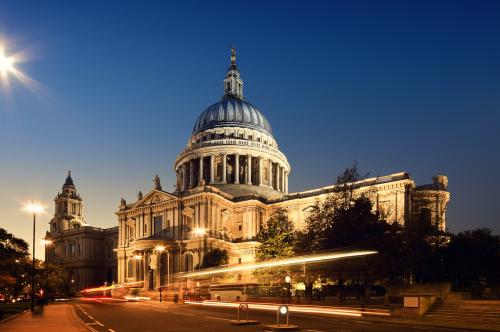
From 1710 to 1962, St. Paul’s Cathedral was the tallest building in London. It is the 2nd largest church in the UK. Its dome is the 3rd largest in the world as well as one of the highest. The towers of the Cathedral contain the 2nd largest ring of bells in the world. St. Pauls also has the largest crypt. St. Paul’s cathedral is a 20 minute tube journey from the best hotel in Paddington – Park Grand London Paddington and is definitely worth a visit.
The Bank of England was founded in 1694 and was the first privately owned national bank in the world.
The world’s oldest public zoo opened in London in 1828.
People leave all kinds of things on the Tube. Some of the most bizarre include a stuffed puffer fish, a coffin, an urn full of ashes, 3 dead bats in a jar and an entire park bench.
The world’sfirst traffic light was erected outside the House of Commons in 1868. It blew up the following year, injuring the policeman operating it.
Only one British Prime Minister, out of 51 who have held the office since 1751, has ever been assassinated. Spencer Perceval was shot at the House of Commons in 1812.
The exact centre of London is marked by a plaque in the Church of St. Martins-in-th0Fields overlooking Trafalgar Square.
St. Thomas’s Hospital used to have seven buildings, one for each day of the week. This was supposedly so staff knew on which day patients had been admitted. Only 2 of the buildings remain today.
Brixton Market was the first electrified market in the country and stands, as a result, on Electric Avenue.
East London is the most popular film location in the city.
The tiered design of St. Bride’s Church in Fleet Street is believed to have been the inspiration for the tiered wedding cake.
Postman’s Park is one of London’s great hidden spots. It is full of memorials to ‘ordinary people’ who committed heroic acts.
The nursery rhyme ‘Pop Goes the Weasel’ refers to the act of pawning one’s suit after spending all of one’s cash in the pubs of Clerkenwell.
The only home shared by all four of the Beatles was a flat at 57 Green Street near Hyde Park, where they lived in the autumn of 1963.
London was the first city to reach a population of more than a million in 1811. It remained the largest city in the world until it was overtaken by Tokyo in 1957.
The first performance of a Punch and Judy Show at Covent Garden was recorded in Samuel Pepys’s diary for 9th May 1662. It is believed a similar puppet show has been seen there every year since.
Pubs in Smithfield are licensed it serve alcohol with breakfast from 7am to fit in with the hours worked by market porters.
Mayfair is named after a fair that used to be held in the area every May; Piccadilly after a kind of stiff collar made by a tailor who lived there in the 17th century; and Covent Garden was originally the market garden for the Convent of Westminster Abbey.
In 1926, John Logie Baird demonstrated how television would work in what is now Bar Italia in Frith Street, Soho.
London’s smallest house is 3 and half feet wide and forms part of the Tyburn Convent in Hyde Park Place, where 20 nuns live.
Post Your Ad Here
Comments