Does a Generator Generate DC or AC
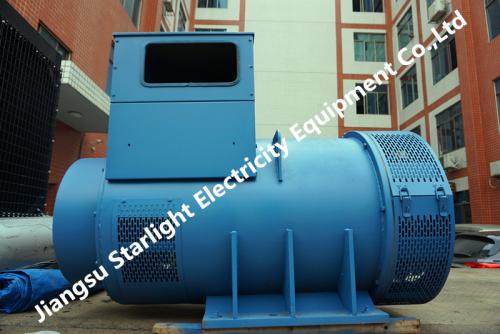
There are two different
ways to generate electricity in a rotating generator. One is to rotate a coils
inside a magnetic field. The problem is to then capture the generated voltage
from a rotating mechanism to bring it to the outside world. This is done by
using brushes and slip rings. But the output is AC.
The rotating coils in a
DC generator are called an armature There are usually many coils connected to
commutator segments.
All rotating generators
generate AC initially in the rotating armature. In a DC generator the
conversion to DC is performed by the commutator and brushes. Capturing the
energy output produced by using brushes is a rather inefficient method.
An alternator uses a
magnetic field rotating inside a set of coils that are fixed in a housing. This
means the energy can be simply connected by wires to the outside world. The
output is AC. This method is much more efficient. The magnetic field is created
by using brushes and slip rings to supply the power to the rotor coils. Much
less energy is lost in this way because the current in the rotor is relatively
low compared to the generated output. The output can easily be converted to DC
by using rectifier diodes.
At the most fundamental
level, a generator is a source. What is generated maybe be power or data, most
any waveform you can think of. However, you are probably making the unsaid
distinction that you want to talk about power generators.
The simplest power
generator is a coil which is moved through a magnetic field. The simplest
mechanical solution to that is to make a coil rotate through the magnetic
field, alternately cutting magnetic lines of force in one direction and then
cutting them again in the opposite direction on the “return” half of the
revolution. This leads to a current being induced in the coil with one polarity
and then an equal current induced in the coil with opposite polarity. If you
view the voltage across the coil, you will see a sine waveform for every
complete revolution of the generator, so we would call this device an
alternator since it creates an alternating output.
If you would like the
alternator to produce a DC output, you have two choices.
You could arrange a
mechanical selector switch (called a commutator) on the rotating coil. This
switch serves to reverse the coil’s output connections every half-rotation. The
voltage output of this device (historically called a generator) is a series of
half-sine waves with peaks at double the rotational frequency. (Think of the
alternator’s positive and negative sine wave and then think that the commutator
“folds” the negative half-cycles up above the zero level.) This does not create
pure DC, but rather a common polarity with a big ripple content.
You could also apply an
alternator’s AC output waveform to an electronic rectifier (no commutator
needed), which would again create a half-sine pulsing DC.
In the automotive World,
historical names for power generators have obscured their true function (just
as automotive capacitors were long called “condensers” despite the fact that
they have nothing to do with condensation). If you took an alternator and equipped
it with a commutator, it created pulsing DC and was called a generator. If you
took an alternator and equipped it with rectifiers, it created pulsing DC and
was called an alternator.
Post Your Ad Here
Comments