Development Trend of Propeller Processing Methods
Development Trend of Propeller Processing Methods
1.Riser Cutting
The riser of small and medium ship propellers is usually cut on a vertical car or a lathe. If large propellers are still cut by vertical cars, they appear to be low in work efficiency, time consuming and costly. Foreign specialized factories all use special feeder cutting to cut the feeder, and the effect is very good. This special machine can be summarized into two kinds: one is to cover the propeller to cut off the riser (upper); the other is to place the propeller on the cutting machine to cut off the riser (downr). The width of the cut has been reduced from 40mm in 1974 to 7mm in 1977. Domestic special feeder cutting machines made following this principle have been put into use.
2. Hub Machining
Now there are special shaft housing processing machines that can process upper and lower end faces, tapered holes, oil grooves (keyless paddles) or keyway (keyed paddles). This machine is easy to guarantee concentricity, perpendicularity and parallelism. The ordinary rocker drilling machine is used to increase the two-leg support and converted into a special machine for shaft shell processing. The machine tool has good stability, high work efficiency and good effect, and is superior to vertical lathe processing. A marine machining propeller factory improved on the basis of the original assembly machine, and used a basket-type combined machine for horizontal processing. Practice results have proved that using this method has high efficiency, low cost, easy to observe the process, and the processing accuracy is no less than that of a vertical car, which is undoubtedly a processing method suitable for national conditions.
3. Foliar Machining
Some companies have so far used hand-powered tools to grind foliar surfaces. Because they leave very little casting allowances, they also have a good grasp of the deformation rate of the castings, and they use CNC electric measuring instruments to measure the machining allowances. The rear page stripes are clearly visible, and there is no bump feeling when you touch it with your hand. There are also companies that use vertical CNC milling machines to process the blade surface. The milling machine can process propellers with a diameter of 9-10m and a weight of 80t. When using this method, the machining castings balance should be kept a bit more, and further grinding and polishing are required by hand after machining. A CNC machine tool designed by a factory has two milling heads, which can be individually controlled separately. This allows the oars with special blades to be processed quickly. The machine tool has a compensation system that enables the milling head to bend and twist when it moves. Reduced to a minimum. Insertion can also be used to adjust the tool position to compensate for casting errors.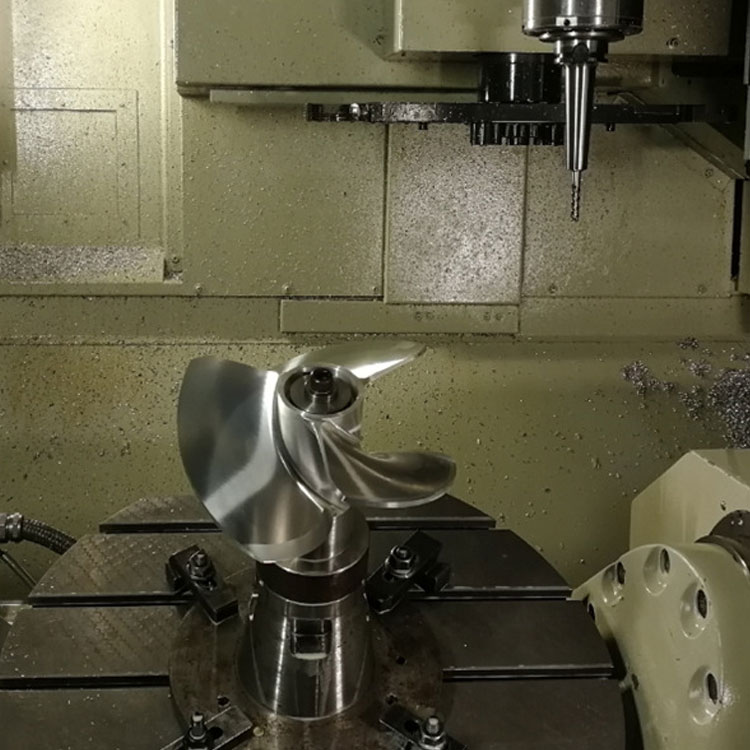
4. Tapping of screw holes
Only in a sample of a factory they saw that they used a radial drill to tap.
5. Research and development of tapered holes and stern shafts
Generally, the taper of the taper hole is 1:20, and the quality of the process is usually tested by using a template or a plug gauge. Make its contact surface reach a certain level. The propeller and the stern shaft are assembled in the same workshop, and the total height after assembly is 13m. Most domestic shipyards also adopt research institutes. When the height of the plant is limited, horizontal research is also used.
ISO 9001:2000 & ISO 14001:2004 certified manufacturer of non-standard boat & ship propellers. Available with 1.22 in. to 1.5 in. OD, 0.095 in. to 0.112 in. ID & 0.500 in. thickness.
It takes knowledge & experience to develop a reliable supply chain for ship propeller&crankshaft . PTJ Shop's in house tooling facility can handle all Ship Machining needs. Call today!
Advertise on APSense
This advertising space is available.
Post Your Ad Here
Post Your Ad Here
Comments