Celebrating Pre-Wedding Rituals, the Hindi Matrimony Way!
Wedding celebrations in India have always been grand, and full of fun and frolic! Matrimonial celebrations in the northern part of India take away the cake when it comes to celebrating with grandeur. In the Hindi speaking states like Uttar Pradesh, Madhya Pradesh, Bihar, Rajasthan and Delhi, the wedding rituals differ with every district but the celebrations and feel remain the same, barring Delhi, where the weddings are all about pomp and show!
The concept of arranged marriages prevails in the Hindi matrimony. Fixing a wedding is a time taking procedure, and the approach is very formal.
Meeting of prospective alliances and matching of horoscopes
Almost 90% of the families shortlist their sons-in-law and daughters-in-law on the basis of their photographs, jobs and horoscopes
Traditionally, no wedding is fixed without the matching of horoscopes. However, there are certain families that do not follow such trends and do not impose matching of the horoscopes. Nevertheless, the older generations have their hard-core belief in the concept of old theories of matching horoscopes and emphasize on the positions of stars and planets for the wellbeing and happiness of couples. Only after studying the complete details of the horoscopes, alliances are finalized.
If everything goes well, both the families then meet over a high tea and discuss the alliance. Usually, first meeting of both the families is considered as a green signal for the prospective alliance, and the families become all set to celebrate this wonderful union of two souls. Marriages are known as Vivaaha in Hindi, which is solemnized as described in the Vedas.
The Engagement
This is usually a small function where bride and groom to be are bestowed upon with different gifts from their in-laws. In the Hindi matrimony, the concept of engagement is not too old and is known as Sagai, Roka or Mangni. The prospective bride and groom exchange rings and the function is generally attended by family members, close relatives and friends, who shower the boy and girl with their blessings and lots of gifts including gold and cash. Families also exchange gifts like clothes, fruits and sweets as a token of love and respect, as well as a symbolism of celebrating the alliance.
Tilak
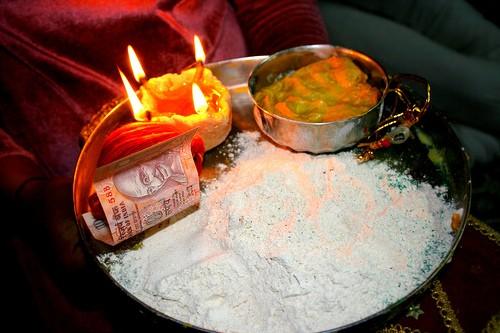
Tilak ceremonial celebrations take place a few days before the wedding. It is a very important ritual in Hindi matrimony, earlier; it was a Vedic ritual but now has become a social function. Ideally, Tilak signifies the acceptance of groom as a competent person to marry the girl. On this auspicious day, the bride’s family pays a visit to the groom’s home, accompanied with a number of gifts, clothes for everyone in the groom’s family, utensils for daily use, sweets, dry fruits, fruits, and other things. The brother or cousin of bride applies Tilak (red vermillion) on the forehead of the groom, and offers him with gifts. A grand feast to welcome the bride’s family is organized.
Sangeet
Both families arrange for Sangeet at their respective homes, where
the female members sing songs and dance to enjoy the essence of wedding. They
dance on the tunes of traditional music as well as on the latest Bollywood songs.
Males are usually not allowed to witness the Sangeet sessions.
Mehendi
Mehendi or henna is considered as a very pious element of the Indian
weddings. It is a custom which is held one night before the wedding day. Traditionally,
an elder female member of the family used to apply henna on the hands of the
bride, while singing wedding songs, but now professionals are called to apply henna
on the hands of the bride and female members. Mehendi ceremony has now taken a glamorous shift and is looked at as
a party or family gathering, where every one enjoys the fun filled moments. In
states like UP, MP and Rajasthan, there is a tradition where the grooms also
have to apply henna on their hands.
Haldi ceremony
Haldi or turmeric ceremony refers to another pre-wedding ritual, which is celebrated just a day before the wedding. This ceremony is held at the homes of both bride and groom. This turmeric paste is prepared with turmeric, sandalwood, oils, and rose water. In certain families, the bride and grooms are adorned with pure turmeric on their faces, hands and feet, and later massaged with oils. It is a beautification process that is believed to clear the skin and make it glow before their D-day. After haldi ceremony, brides and grooms are not allowed to step outside until the wedding day.

Post Your Ad Here
Comments