Camels, Colours and Culture of Rajasthan
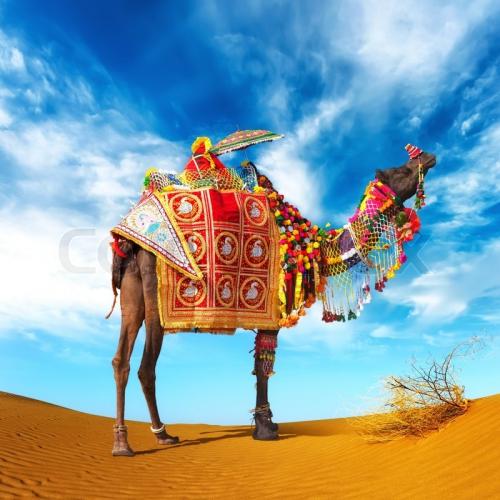
Tawny, Brown, Ochre, Gold and Beige; what other colours does the word `desert' conjure up? And what images does that word bring to mind? Of a dull, lifeless land, where nothing lives and nothing flourishes? A land dominated by howling winds that bring not succour, but sand-and a sun that burns overhead, scorching the earth below into a series of parched, cracked wastes?
Come to Rajasthan and you might just end up revising your views of what a desert should be like. True, India's largest state (also the country's westernmost state) is mainly desert, but this is a desert that throbs with life. And when we talk of life, we don't just mean the sandfish that wriggle beneath the sands of the Desert National Park or the long trains of camels one sees meandering their way across the dunes. We mean life at its most colourful, joyous best. Life, the way only Rajasthan can offer: vivid, vibrant, and uninhibited.
Rajasthan is India's most visited state. A long and glorious past, and a martial heritage that stretches back to more than ten centuries ago make this a state with monuments by the dozen. Imposing forts, stunningly beautiful palaces, fresco-painted havelis and exquisitely carved temples lie literally every step along the way. And the way itself-interspersed with colourful villages where the huts are decorated with line drawings; where the women still wear colourful odhnis and swirling ghagras; where the men still sport massive red and orange turbans and splendidly fierce moustaches-is exotica in its ultimate form.
Rajasthan first came into the limelight during the 5th and 6th centuries, when Rajput warrior clans like the Sisodias and the Kacchhwahas began to emerge. Over the centuries that followed, these acquired a reputation for valour that has endured till modern times — a reputation that eventually brought the Rajputs closer to the Mughals (who, realising the power of their rivals, decided that friendship was the best policy), and later, to the British. Today, Rajasthan holds within its enticing embrace many reminders of its interesting history: that which was influenced by the Mughals and the British, as well as that which is typically Rajasthani.
For the eager-beaver traveller ready for the experience of a lifetime, Rajasthan has much to offer. The luxury-living can opt for tours on plush trains like the Palace on Wheels and the Fairy Queen, or spend time in heritage hotels-erstwhile palaces-being pampered with all the luxuries enjoyed by the maharajas of yore. Culture-vultures yearning for a glimpse of the entire colour they've always associated India with can have their fill of full-throated folksongs, joyous dances, and handicrafts by the ton — camel leather shoes, brightly painted wall-hangings, appliqué, carved wood, embroideries, block-printed textiles, jewellery and more. The adventurous can head for the eastern half of the state, where the green, sheltering ranges of the Aravali Hills and its environs are home to some of India's finest wildlife parks: Sariska, Ranthambhore, Keoladeo Ghana... or they can go right across Rajasthan, to its westernmost edge, where the harsh and forbidding expanses of the Thar Desert are perfect for a camel safari that you are guaranteed to remember! Come to Rajasthan. Follow in the footsteps of countless others, from medieval merchants and conquerors to latter-day tourists who arrive in thousands every year. So many people, so many millions, couldn't be all wrong.
For more information on Camels, Colours and Culture of Rajasthan and Rajasthan tour packages contact Swan Tours one of the leading travel agents in India.
Post Your Ad Here
Comments