ANOTHER HARDWARE ALTERNATIVE FOR ML AND AI or Artificial Intelligence: QUANTUM COMPUTING
Quantum
computing is continuing to scale up and with the recent announcement from the
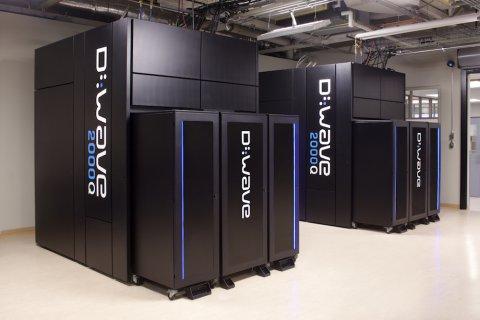
Vancouver based quantum computing company, D-Wave, of their 2,000-qubit
processor it does not show signs of slowing down. D-Wave is the first quantum
computing company that has made the technology available for commercial use.
The quantum computing processors are in direct competition with the more
tradition types of chips used for Machine Learning and AI like
GPUs and the newly announced second-generation TPU from Google.
The important part of quantum
computing is that it replaces the traditional way of thinking of computing. By
replacing the conventional bit, 0 or 1, with a new type of information, it
opens up to exponential amounts of possibilities. The qubit can be in the
superposition state where it is neither +1 or -1 yet, in a sense it is both,
and it is this that allows for the superfast computing.
The D-Wave quantum computers use
the process of annealing. This involves a series of microscopic magnets to be
arrange on a grid. Each magnetic field influences each other and then they
orient themselves into a position to minimize the amount of energy stored in
the entire field. It is during this process, that one can change the strength
of the magnetic field from each magnet so that the magnets orient themselves in
a way to solve specific problems. To get to the solution, you begin with high
amounts of energy so it is easy for the magnets to flip back and forth. Then as
you lower the temperature, the magnets reach lower and lower levels of energy
until they are frozen into the lowest energy state. Here it is possible to read
the orientation of each magnet and find the answer to the problem. One can say
that D-Wave’s quantum computer is a kind of analog computer relying on Nature’s
algorithms to find the configuration of the lowest energy state.

This is where we get lucky. This
specific class of quantum computing happens to be useful for a subset of
optimization computing problems, especially those geared towards Machine
Learning. Many Machine Learning
problems can be reformulated as energy problems. The D-Wave quantum computers
are designed to support problems that need high level reasoning followed by
decision making. The quantum computing allows for AI or Artificial Intelligence systems to imitate human thought processes much more closely than a
classical processor. And while the idea of quantum computing can be hard to
understand, its use in Machine Learning is clearly opening up new
opportunities.
In the impending fight between
the GPUs and TPUs, there is a possibility that quantum computing will pass in
the outside lane. A key element in D-Wave’s quantum computing is that it
isn’t necessarily designed to solve every problem but it is addressing the same
need in the processing market that GPUs currently fulfill. Google released a
paper in which they find that there is a considerable computational
advantage when using the D-Wave quantum computer over a classical processor. In
many aspects, a quantum computer can do the same thing a GPU can do, just
faster, and these days, time is money.
Post Your Ad Here
Comments