Alternative Medicine for Retroperitoneal Fibrosis - Rare Disease
Abstract
Retroperitoneum is the potential anatomical space behind the peritoneum that contains the structure which is not suspended by myscentry in the abdominal cavity. The main structures in the retroperitoneal area are ureters, kidneys, abdominal aorta, etc. Due to some causes, there is a growth of excess connective tissue which leads to Fibrosis of these retroperitoneal structures. Such a rare disease is retroperitoneal Fibrosis which is also known as Ormond’s disease. In this article we are going to discuss Retroperitoneal Fibrosis, its sign and symptoms, cause and Herbal Management of Retroperitoneal Fibrosis.
Introduction
Retroperitoneal Fibrosis may be defined as the rare condition that occurs when the excessive growth of fibrous tissue occurs in the retroperitoneal area (space behind your intestine and stomach). The mass develops due to excessive growth of connective tissue results in blockage of ureters. One or both of your ureters are blocked due to tissue mass.Ureters are the part of the urinary system that carries urine from the kidney to the bladder. Toxic materials can build up in the blood because urine backs up in the ureters. This condition leads to kidney failure. This condition starts with Fibrosis and inflammation of the abdominal aorta. Aorta is the largest artery of the body that carries blood from the heart to areas below the kidneys. If this disease is left untreated, it blocks the artery that carries blood to your kidney and legs. A reduction in kidney function, leg swelling and pain can occur.

Symptoms of Retroperitoneal Fibrosis
Due To Retroperitoneal Fibrosis Blood Flow From The Aorta To The Lower Part Of The Body Is Decreased. Some Symptoms That May Occur Due To Reduced Blood Flow Are
- Severe leg pain
- Pain on one side between your back and upper abdomen
- Dull pain in the back or an abdomen that may be hard to pinpoint
- Discoloration of legs
- Swelling
- Intense pain in the abdomen with bleeding
Other Symptoms Include
- Loss of Appetite
- Loss of Weight
- Fever
- Vomiting and Nausea
- Decreased Urine Production
- An Inability to Urinate
- Impaired limb Movement
- Decreased level of RBCs (Red blood cells)
- Kidney Failure
Causes
In 60% of cases, the specific cause of Retroperitoneal Fibrosis is unknown. Gender and age are the huge risk factors for the disease. It can develop at any age but it mostly occurs between the age of 40 and 60. Compared to women, men are more infected with this disease. This disease is related to a specific condition in 15 to 25% of cases.
These can Include
- Bacterial infection such as Actinomycosis.
- Fungal infections such as Histoplasmosis.
- Tuberculosis
- Pelvic or abdominal tumors
- Recent trauma of the pelvis or abdomen.
This Disease Can Also Be Related To Recent Surgery on the Pelvis or Abdomen, Cancer Treatments Like External Beam Radiation, Medicines Used In The Treatment Of High Blood Pressure And Migraines.
Complications
Complications with this disease may vary with the location and size of excess tissue growth. Because excessive tissue growth results in damage of several areas served by the abdominal aorta. Blockage and swelling of the ureters result in long term blockage of the ureters and chronic kidney failure. This condition results in kidney swelling and urine back up
Herbal Medicines Provided By Planet Ayurveda:
Planet Ayurveda provides herbal products that contain 100% natural products i.e. Boswellia Curcumin capsules, Mahashankh vati, Nephralka capsules, Punarnava capsules, Chandanadi vati in the management of Retroperitoneal Fibrosis. All herbs used in the formulation of these products are explained in ancient Ayurveda texts. These products are also free from chemicals, preservatives, binders, colors, etc.
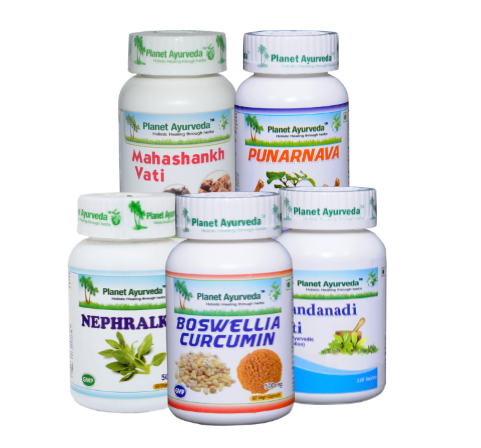

Our Experts Proposed Herbal Formulations for Retroperitoneal Fibrosis
- Boswellia Curcumin Capsules
- Mahashankh Vati
- Nephralka Capsules
- Punarnava Capsules
- Chandanadi Vati
Full Description of Herbal Formulations for Retroperitoneal Fibrosis
1. Boswellia Curcumin Capsules
The two major constituents of Boswellia Curcumin capsules are Shallaki (Boswellia Serrata) and Haridra (Curcuma longa). It is beneficial to reduce inflammation of the aorta that is present in the abdominal region and helps to prevent Retroperitoneal Fibrosis. It also helps to lower down the pain in the legs, abdomen, and back.
Dosage: 1 capsule twice daily, after meals with plain water.
2. Mahashankh Vati
Various kinds of salts such as rock salt, black salt, and sea salt and herbs such as Shunthi (Zingiber officinale), Pippli (Piper longum), and Shuddha Vatsanabha, etc. are used in the preparation of this vati. This product is fully packed with minerals and herbs. It is beneficial to treat symptoms of Retroperitoneal Fibrosis such as loss of appetite, nausea, etc. It also helps to boost up the immunity.
Dosage: 1-2 tablets twice or thrice daily with lukewarm water.
3. Nephralka Capsules
Nephralka capsules are prepared with the help of extract of several herbal ingredients such as Bhumi amla (Phyllanthus niruri), Mooli satva (Raphanus sativus), Revandchini (Rheum emodi), Kalmegh (Andrographis paniculata), etc. It is helpful in the removal of toxins present in the blood. It is also beneficial to maintain the proper functioning of the kidney and also prevents injury to the kidney. These capsules are used for the balancing of Tridosha (Vata, Pitta, and Kapha).
Dosage: 1-2 Capsules twice daily, with plain water, after meals.
4. Punarnava Capsules
Punarnava capsules are formulated with the help of a standardized extract of Punarnava (Boerhavia diffusa). These capsules also assist in the regeneration of new cells. Due to its diuretic activity, it helps in the elimination of toxic substances from the body that is accumulated in the blood. It is helpful for the balancing of Vata and Kapha Dosha. It is primarily used for urinary and kidney disorders.
Dosage: 1-2 Capsules twice daily, with plain water, after meals.
5. Chandanadi Vati
Chandanadi Vati is formulated with the help of more than 10 herbal ingredients i.e.
- Amalaki (Emblica officinalis)
- Safed Chandan (Santlum album)
- Chotti elaichi (Elettaria cardamomum)
- Gokshur (Tribulus terrestris)
- Karpoor (Camphora Officinarum), etc.
It helps to maintain the digestion and metabolism of the body. It also improves the blood circulation of the body. It also helps in the balancing of Pitta and Kapha Dosha. It is beneficial in the management of Retroperitoneal Fibrosis by eliminating toxins from the blood, treating obstructed blood supply, treating loss of appetite, and nausea. It also imparts a soothing and cooling action.
Dosage: 1-2 tablets twice or thrice daily with lukewarm water
Conclusion
In this article, we can see that in modern medicines, there is a surgical procedure, insertion of a stent or drainage tubes are used in the management of Retroperitoneal Fibrosis. In Ayurveda, Various herbal remedies with no side effects are used in the treatment of this disorder. These herbal remedies are 100% safe and effective. These medicines lower down symptoms or associated factors that are responsible for the cause of this disease.
Post Your Ad Here
Comments