HIPAA- What Is IT?
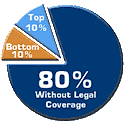
Note: Some times understanding our rights is not always enough, our rights must be in forced. We have become use to the abuse due to lack of access to our legal system and this has caused us to become the victims of in justice.
Top 10% can pay the retainer at $200 + $ an hour. The bottom 10% receives legal aid and gets limited help. Therefore, that leaves 80% with no coverage.
Understanding HIPAA Privacy
The Privacy Rule provides federal protections for personal health information held by covered entities and gives patients an array of rights with respect to that information. At the same time, the Privacy Rule is balanced so that it permits the disclosure of personal health information needed for patient care and other important purposes.
Your Health Information Is Protected By Federal Law
Most of us believe that our medical and other health information is private and should be protected, and we want to know who has this information. The Privacy Rule, a Federal law, gives you rights over your health information and sets rules and limits on who can look at and receive your health information.
Who Must Follow This Law
We call the entities that must follow the Privacy Rule covered entities.
Covered entities include:
Health Plans, including health insurance companies, HMOs, company health plans, and certain government programs that pay for health care, such as Medicare and Medicaid.
Most Health Care Providers—those that conduct certain business electronically, such as electronically billing your health insurance—including most doctors, clinics, hospitals, psychologists, chiropractors, nursing homes, pharmacies, and dentists.
Health Care Clearinghouses—entities that process nonstandard health information they receive from another entity into a standard (i.e., standard electronic format or data content), or vice versa.
—entities that process nonstandard health information they receive from another entity into a standard (i.e., standard electronic format or data content), or vice versa.Who Must Follow This Law
We call the entities that must follow the Privacy Rule covered entities.
Covered entities include:
Health Plans, including health insurance companies, HMOs, company health plans, and certain government programs that pay for health care, such as Medicare and Medicaid.
Most Health Care Providers—those that conduct certain business electronically, such as electronically billing your health insurance—including most doctors, clinics, hospitals, psychologists, chiropractors, nursing homes, pharmacies, and dentists.
Health Care Clearinghouses—entities that process nonstandard health information they receive from another entity into a standard (i.e., standard electronic format or data content), or vice versa.
—entities that process nonstandard health information they receive from another entity into a standard (i.e., standard electronic format or data content), or vice versa.Who Is Not Required to Follow This Law
Many organizations that have health information about you do not have to follow this law.
Examples of organizations that do not have to follow the Privacy Rule include:
the Privacy Rule include:life insurers,
employers,
workers compensation carriers, many schools and school districts, many state agencies like child protective service agencies, many law enforcement agencies, many municipal offices. What Information Is Protected Information your doctors, nurses, and other health care providers put in your medical record Conversations your doctor has about your care or treatment with nurses and others Information about you in your health insurer’s computer system Billing information about you at your clinic Most other health information about you held by those who must follow this law How Is This Information Protected Covered entities must put in place safeguards to protect your health information. Covered entities must reasonably limit uses and disclosures to the minimum necessary to accomplish their intended purpose. Covered entities must have contracts in place with their contractors and others ensuring that they use and disclose your health information properly and safeguard it appropriately. Covered entities must have procedures in place to limit who can view and access your health information as well as implement training programs for employees about how to protect your health information. What Rights Does This Law Give Me Over My Health Information Health Insurers and Providers who are covered entities must comply with your right to: Ask to see and get a copy of your health records Have corrections added to your health information Receive a notice that tells you how your health information may be used and shared Decide if you want to give your permission before your health information can be used or shared for certain purposes, such as for marketing Get a report on when and why your health information was shared for certain purposes If you believe your rights are being denied or your health information isn’t being protected, you can File a complaint with your provider or health insurer File a complaint with the U.S. Government You should get to know these important rights, which help you protect your health information. You can ask your provider or health insurer questions about your rights. Who Can Look at and Receive Your Health Information The law sets rules and limits on who can look at and receive your health information To make sure that your health information is protected in a way that does not interfere with your health care, your information can be used and shared: For your treatment and care coordination To pay doctors and hospitals for your health care and to help run their businesses With your family, relatives, friends, or others you identify who are involved with your health care or your health care bills, unless you object To make sure doctors give good care and nursing homes are clean and safe To protect the public's health, such as by reporting when the flu is in your area To make required reports to the police, such as reporting gunshot wounds Your health information cannot be used or shared without your written permission unless this law allows it. For example, without your authorization, your provider generally cannot: Give your information to your employer Use or share your information for marketing or advertising purposes Share private notes about your health care Understanding HIPAA Privacy http://www.hhs.gov/ocr/privacy/hipaa/understanding/index.html
Post Your Ad Here
Comments